Showing posts with label Reviews. Show all posts

Saturday, April 26, 2014

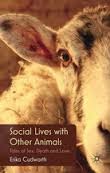
Review: Social Lives with Other Animals


You may have to be a real theory junkie to enjoy this book! I must admit, I found the first couple of chapters trying--I believe most would probably not be interested enough to continue(This is why I did not give the book 5 stars). Thus far, though, this is one of the most (if not the most) comprehensive sociological texts on human and nonhuman relationships. Most of the book is a review of the literature, exploring the fields of post-humanism, human animal studies, animal rights, and ecofeminism. I would not recommend this book for a beginner--this book is best suited to A) professionals or graduate students already in animal studies fields who are interested in the sociological literature on other animals or B) Sociologists interested in learning what the discipline has to offer species studies. I believe her intended audience is likely the latter, as there is a lot of effort put into explaining the living conditions of animals that would be well understood by those already studying animal issues. Indeed, while Sociology has historically been extremely exclusionary when it comes to other animals (a frustrating short sight given the emancipatory/critical nature of the field), Cudworth is able to ground the growing interest in animal studies in a rich(and interdisciplinary) body of work from contemporary Sociologists all the way back to the founding theorists(Marx, etc.). 

Again, the first chapters are primarily a review of the literature, but the meat of the book unpacks important concepts in speciesism. Chapter 4 covers the important gender variable in our relationships with other animals based on the work of Carol Adams. Though he is not referenced, Brian Luke's theory of masculinity and animal violence is heavily evidenced in her discussion of gendered foodwork and animal industry. Chapter 5 offers an overview of the institutionalized violence animals endure. Chapter 6 makes the case that humans and other animals have meaningful relationships. She explores this with an ethnographic study of human-nonhuman communities that form around dog-walking.


As with any social scientist worth paying attention to, she grounds her theory in emancipatory anti-speciesist practice. She extends quite a bit of effort criticizing some prevailing positions that, on the surface, may seem to be critical of speciesism, but ultimately make serious exceptions for continued oppression (so long as that oppression is made "nicer"). Cudworth introduces the concept of an "anthroparchy" to specifically view our relationship with other animals as a system of domination, oppression, and marginalization. Speciesism is not so simple as a mere prejudice for other animals--it is a historically situated project of human supremacy and animal exploitation. It is a system that benefits humans at the expense of vulnerable nonhuman animals. Addressing this system means ending this system, not reforming it. 

A side note--something I couldn't help but take issue with--she mentions that Gary Francione is rightly critical of reform approaches. However, she claims that he incorrectly has faith in law (and, thus, the state) in liberating other animals. I think this is a mischaracterization of his approach. She is right to say that he is critical of the law as it stands, but Francione believes that grassroots bottom-up vegan education that attacks speciesist ideology is the preferred strategy (and he is extremely critical of legal campaigns that seek to improve laws for animals). Francione operates according to a simplistic "supply and demand" logic that supposes that 1. Attacking speciesist ideology with vegan education and 2. Increasing vegan numbers to create a critical mass will 3. Dismantle speciesism. Nibert's approach is probably a better criticism to Francione's work in this regard, as Nibert places more emphasis on the inherent oppressiveness of the capitalist system. Most Sociologists agree that a capitalist state will always be oppressive. Francione seems to think that capitalism can work in favor of animals if we replace non-vegan industry with vegan industry. Perhaps this is what Cudworth was hinting at in her criticism, but her exploration into Francione's approach did not exceed more than a couple of sentences. Francione certainly isn't making the case that we look to the state to save animals. Indeed, he is highly critical of state institutions, bureaucracy, and hierarchy. However, Francione seems to think that the economy reflects ideology, but Sociology argues the opposite--ideology (and institutions) reflect our economic mode of production. Therefore, any attack on speciesism must also be an attack on capitalism.

Because this book is terribly dry at times (as it is basically an extensive summary of theory), I would not recommend it to the lay reader, but would probably suggest David Nibert's work instead or at least read them together. Nibert's work makes very similar arguments but is written in a more engaging way. Cudworth's book is probably best reserved for the serious academic or researcher. On the other hand, Cudworth's nuanced discussion of gender, foodwork, and animal exploitation, however, (heavily influenced by Carol Adams' sexual politics of meat) is an important extension on Nibert's work. 

All in all, a very useful addition to the growing Sociology of critical animal studies. Worth having on the shelf as an excellent resource and reference to the field. If you want to learn the sociological position on animal oppression--this is the "go to" text. For seasoned Sociologists, Cudworth's case for the inclusion of species politics is remarkably solid--I can't imagine any social scientist walking away from this book unconvinced. Nonhuman animals are part of our lives and part of our social world. We form relationships and communities with them. We benefit from them. They structure our reality. They also exist within systems of oppression in much the same way that vulnerable humans do--a relationship of violence that we have a moral obligation to recognize.

Monday, April 14, 2014

Review: The Ecological Hoofprint

The Ecological Hoofprint:  The Global Burden of Industrial Livestock was recommended to me by David Nibert as it is sociologically oriented and critical of animal product consumption.  It provides an excellent summary of the major environmental arguments against meat in the context of global inequality and the agricultural industrial complex.  It is a good companion to Meatonomics, This is Hope: Green Vegans and the New Human Ecology, and David Nibert’s work.  In general, I think this work is an excellent introduction into the sociology of food systems and environmental sociology.  It also speaks to animals & society discourse, though it is decidedly anthropocentric and speciesist in its conclusions.

It is very intersectional and critical of capitalism, tracing the historical process towards the system we have today. Weis argues that, in earlier times, most energy came from the sun (rather than fossil fuels) and travel was restricted because it was not efficient (a phenomenon he calls the “friction of distance”). Because the farmers couldn’t move around much, they had to take care of what resources they had locally available and farm more responsibly.  However, capitalism eroded this friction of distance with the rise of globalization and colonialism.  This has led to large scale environmental destruction and climate change.


The book also discusses how environmentalism has been framed in a way that obscures problems and protects capitalist interests.  Weis is refreshingly critical of the overpopulation rhetoric that blames environmental degradation on population (i.e. poor people and vulnerable communities).  This position ignores the role that livestock production plays.  He calls this focus on human population “corporate greenwash” and is critical of how technology, development, and capitalist growth are reframed as solutions, when they are, in fact, the problem.  Overpopulation rhetoric obscures global inequality and focuses on the more easily targeted “distant other”:
Rather than the persistence of high fertility rates being a cause of poverty and degradation, critics counter, these are better understood as a symptom or an effect of things like class, patriarchy, and other inequalities, and the dependence of the poor upon children for such things as labor and old-age security. (35)
This is perhaps the crux of his argument: We are ignoring the Nonhuman Animal component:
The ecological footprint presents a call to understand consumption in terms of the bundles of land, water, resources, pollution, and GHG emissions embedded in production, and in turn the tremendous environmental dimension of economic inequalities. The ecological hoofprint seeks to connect and extend some of these basic concerns to a different and much bigger ‘population bomb’ than what environmentalists have long focused upon: that which is occurring within systems of industrial livestock production. (50) 
A primary goal of the ecological hoofprint as a concept and metaphor is to call attention to the large, wide-ranging, and highly uneven burden of industrial livestock production.  To do this, it develops a political ecological framework for understanding the industrial grain-oilseed-livestock complex as a system in motion, and how its fundamental economic logic (or imperatives) gives shape to the social and ecological relations of production, including the associated instabilities and the ways they are overridden. (52)
Unfortunately, Weis operates under the assumption that animal products are good for human health, which is indicative that he has not addressed the volumes of research that have demonstrated quite the opposite.  He also hangs on to the falsehood that animal production could ideally be beneficial to humanity, even suggesting that small scale animal agriculture can be beneficial to the environment.  However, he does admit that not all societies relied on livestock or required it.  He also challenges the “contract” justification between humans and other animals (the fantasy that Nonhuman Animals happily give up their children, labor, and lives to be "cared for").  He rightfully refers to this as violent and evidence of human supremacy.  Much of the book also reiterates Nibert’s arguments and claims that animal agriculture is inherently tied to class and gender exploitation as well as colonialist expansion.  The rise of animal agriculture is a project of colonization and oppression.

To some degree, Weis is critical of the objectification of Nonhuman Animals and is quite critical of welfare reform (as it supports the logic of capitalism and only seeks to make industry more efficient).  However, it appears that the return to Old MacDonald's Farm is his ultimate desire:
An ecologically rational conception of efficiency thus turns a basic tenet of modernization on its head: rather than technology displacing labor in large monocultures, there is a need for labor and knowledge to displace mechanization. [ . . . ] In the course of rethinking efficiency, ways must be found to ensure equitable outcomes that valorize the labor, skill, and ecological services of bio-intensive farms [ . . . ].  What this analysis makes clear, though, is that dismantling the industrial-grain-oilseed-livestock complex is at the very center of any hopes of making world agriculture more sustainable, socially just, and humane” (149).
Weis suggests the “livestock population bomb” be addressed to reduce the livestock population dramatically.  He ends with a discussion of vegetarianism, humane farms, and veganism, but is very wishy-washy about veganism, indicating
that it is unrealistic or unnecessary.  This, I believe, is the greatest weakness of the book. Though the majority of the book was astonishingly intersectional, well-argued, and sociologically-sound, his stubborn refusal to seriously acknowledge the scientific research demonstrating the toxic effect of animal products on human health makes this book one I would probably not recommend.  No book that claims to take on environmental problems and issues of social justice but sells out the animals and continues to view them as expendable commodities will be credible social science in my opinion.  For this reason, I would direct readers interested in these topics to the books recommended at the beginning of this review, primarily that of David Nibert.

UPDATE 04/16/2014:

The author has since contacted me and is not happy with some of the conclusions I've drawn, specifically in my claims that he does not address the health risks of animal-based diets and the desire for a turn to "humane" farming practices.  I encourage readers to read the book for themselves and form their own conclusions.  This essay is a reposting from a review I posted on my Goodreads.com account. In that review, I gave the book 4 out of 5 stars, as I do think the book has quite a bit to offer the field. Given the choice, however, I would still recommend Meatonomics, This is Hope, or Nibert's 2002 and 2013 publications over this one.

Wednesday, February 26, 2014

Book Review: Meatonomic$

David Robinson Simon. 2013. Meatonomics: How the Rigged Economics of Meat and Dairy Make You Consume Too Much--and How to Eat Better, Live Longer, and Spend Smarter. San Francisco, CA: Conari Press.

This book is well researched and extremely engaging. While I have been studying Nonhuman Animal rights issues for many years, I found a lot of new information in this book as well as some new perspectives. Simon makes the argument that the traditional three-pronged approach to animal consumption (ethics, environment and health) needs to recognize a fourth component: economics. 

So often, vegan advocacy portrays speciesism as a matter of supply and demand, but the elite control over both our food supply and our government makes "voting with your dollar" short-sighted. Even those who abstain from animal use still pay for the system with their tax dollars that subsidize meat and dairy advertising and the health and environmental damage that impacts our society as a whole. 

Advocates are up against a serious challenge: Meat and dairy industries are hugely subsidized and they use their strength to create increasing demands for their products and stifle alternatives to them. But we are not only paying for this out of our pocket, but also through skyrocketing healthcare costs, environmental damage, and inefficient food production. Nonhuman Animals pay the dearest price of all, as their lives are commodified for corporate gain.

I appreciated that the author did not spend time rehashing the same descriptions of CAFOs, but instead dedicated quite a bit of time discussing so-called "green" facilities, "happy" farms," and aquaculture. Indeed, one of the common retorts to vegan arguments is that animal production can be made sustainable or even humane. Simon goes to great detail to debunk these positions as mere fantasy. Producing Nonhuman Animals for food will always be polluting and resource intensive; it can never be truly sustainable.

My main concern with this book is that it does not make a strong enough case for veganism as I would like. On one hand, the author makes it clear that consuming animal products is both detrimental and unnecessary, but on the other, he gives people the option to simply "cut back." Because the author so often compares animal consumption to tobacco use, I found this unfortunate. Just as we would not advise people to cut down on cigarettes (but instead to quit entirely), we would not want to advise them to cut down on animal products. This is because maintaining the habit in any form usually works against people actually quitting. It maintains the notion that these products are something to be consumed, if only in moderation, when in actuality, they are highly dangerous and should be cut out entirely.


That said, I believe the comprehensiveness of the research and the topics covered make this an essential read for nonvegans and vegans alike. Importantly, the author creates conceptualizations of the material. Instead of spouting off statistics, he puts the information in perspective. How crowded is aquaculture? 27 foot long trouts are crammed into a space the size of a bathtub. For that matter, the complexities of elite-state collusion in the capitalist system can be confusing (probably a main reason why these gross injustices are allowed to perpetuate), but Simon does an excellent job at explaining them. For its ease of readability and its conciseness (it's less than 200 pages), I think it would be an excellent assigned reading for college courses. He also has lots of supplementary material hosted on the website, which I intend to incorporate into my lectures.

Finally, I really enjoyed reading his proposed solutions, which were quite sound. It seems that if a meat tax were instilled in tandem with some reconfiguring of governmental duties, some serious change could happen for Nonhuman Animals. We know that major social change does not sustain without the political structures to support it. However, we also know that without the public support for that institutional change, the interests of those in power can overcome any serious attempts to check their power. So, while I would love to see a tax and other restrictions that make animal products just as undesirable as tobacco, I don't see that happening until those powerful persons who stand to lose are challenged. That is, the system that allows a small group of elites and corporations to run our society must be challenged. That would entail some major collective action and a challenge to the capitalist system itself. So, while Simon might be suggesting that we start lobbying for a meat tax, I think we need to build a critical mass of vegans before that is a viable option.