Wednesday, July 29, 2015

Students Think Vegan Food Tastes Better, Research Finds

Researchers suspect familiarity with veganism is increasing fondness for plant-based fare

A 2015 publication in Food Quality and Preference finds that college students are more receptive to veganism than non-profits and policy makers may be willing to admit.* The study suggests that foods that are similar will elicit similar responses, regardless of ingredients and origin.

Eighty students were provided a number of vegan and non-vegan food items, some were aware that the products were vegan or non-vegan, but others were not. The results?
Vegan products were not rated as less familiar than the animal-based equivalents. Even when people were told that they were eating vegan substitutes, their familiarity ratings were no different from those of subjects who were told they were eating foods of animal origin.  
[...]subjects did not indicate that they were less willing to try vegan products or foods they thought were vegan than the foods of animal origin or those they thought were of animal origin. 
[...]subjects also did not find the foods that were vegan or that they were told were vegan as more dangerous or disgusting than the foods that were of animal origin or that they were told were of animal origin.  
[...] there was no difference in expected liking for the taste of the foods [...] between the vegan and animal-based versions of the foods nor was there a difference in expected liking between subjects who were told they were rating vegan foods and those told they were rating animal-based foods.
Researchers also find that, for the most part, believing a food to be vegan actually increased how much the participants liked the taste. The only significant exception was vegan chocolate milk. The Daiya-based vegan macaroni and cheese even did well . . . until students were told it was vegan. Meatballs, both animal-based and plant-based, were the only items that were snubbed as disgusting, presumably because college students are not as familiar with meatballs as they are with the other foods in the study (chicken tenders, milkshakes, and macaroni & cheese).

Vegan or not? Students can't tell the difference.

Researchers suppose that this familiarity and openness to veganism could be a result of increased accessibility to vegan options for students of this particular campus. Their access is also increased by living in a metropolitan area (the study took place just outside of New York City). The New York/New Jersey/Pennsylvania area has a well-established vegan community with a number of restaurants and grocery stores offering vegan options.

What does this mean for non-profits that refuse to promote veganism?

Popularizing veganism increases positive associations for veganism, and folks seem to be quite receptive to trying vegan foods. They even like many of the vegan foods more than the non-vegan foods. So, it is suspicious that non-profits are so insistent that the public will not be receptive to veganism and we must "meet them where they are." Non-profits rely on elite- and corporate-run foundations for funding, and many of these elites and corporations have relied on speciesism and oppression to amass their wealth and have no interest in dismantling inequality. As a result, vegan advocacy tends to be ignored by foundations and high-dollar individual donors, thereby encouraging non-profits to diminish or even demonize veganism as a strategy of survival and growth.

This research supports the notion that the continued invisibility and stigmatization of veganism facilitated by non-profits will only inhibit progress for vulnerable humans and nonhumans that would benefit greatly from veganism.

*This study specifically explores veganism as a diet, though participants were aware of the ethical considerations behind the food choices to the extent that it shaped their responses.

Work Cited
S. Adise, I. Gavdanovich, & D. Zellner. 2015. "Looks Like Chicken: Exploring the Law of Similarity in Evaluation of Foods of Animal Origin and their Vegan Substitutes." Food Quality and Preference 41: 52-59.

Friday, April 3, 2015

Corey Wrenn featured on Under the Toadstool


I joined Sonia Chauhan and Sarah K. Woodcock on their Under the Toadstool podcast for a serious discussion about the state of sexism in the Nonhuman Animal rights movement. In this episode, we talk about the history of sexism in the movement, current events in sexism, and concrete steps we can take to disrupt it. I highly recommend this episode as an introduction to intersectionality topics in vegan spaces. We worked hard to keep it short (42 min.) so it will not be overwhelming. A mild trigger warning: we do speak frankly about these issues, and it could be upsetting for those personally impacted.

Thursday, March 26, 2015

Should We Troll Tom Regan?


For women like myself with an active and public presence on the internet, we are fully aware that we "set ourselves up" for abuse by simply being present and by having an educated opinion.  Women are expected to be silent and invisible. For those who dare to disobey these gender norms, retribution is swift.

Whenever I publish something critical of violent tactics, I can expect a fresh onslaught from advocates who are violently opposed to my stance against violence and are dead set on "teaching me a lesson" or shutting me up.  Female colleagues who share my work sadly experience similar punishment. It is unfortunately lost on many that aggressive retaliation of this kind is also a form of violence, especially when it is directed at women and relies on scripts of sexism.

The thing is, a number of male-identified leaders in the movement are quite outspoken about illegal or violent direct action. Tom Regan, for instance, regularly publishes and lectures on the problems with violence in the name of Nonhuman Animal liberation. Indeed, an entire chapter of Empty Cages (2004) chastises violent advocacy. How can it be that Regan and other men like him can contribute ideas so freely?

First, retaliation against women who are critical of violence tends to reflect gender policing. That is, a male-led movement will turn on women who challenge patriarchal norms in order to push them back into their proper feminine roles of subservience and silence.

Retaliation also reflects a general devaluation of femininity. While men can be opposed to violence as well, we recognize that aggression and violence is associated with masculinity, while peace-making and non-violent, inclusive, education-based advocacy is associated with femininity. Therefore, when male activists gang up on women speaking out against violence, they're actually reacting to their discomfort with (and even disdain for) feminist politics and women's power.


Tom Regan is our great movement patriarch, so going for his jugular over his anti-violence position seems unthinkable. We pay deference to men, but we distrust women. Male leaders and activists get to disagree and still have their positions relatively respected. Men's ideas get full consideration; women's get tone-policed. Men are acknowledged as equal participants; women's motives are questioned. For women who speak out, there will be a price to be paid.

Though some male-identified activists surely do face a good bit of criticism, we do not inhabit a post-gendered society. What this means is that men and women will not be criticized similarly, and the consequences of that criticism will not be comparable. Male privilege will always buffer the blow.

Until direct action advocates are prepared to blast Tom Regan with trolling and sealioning with the same ferocity that female activists experience, we must recognize this for what it is: sexism. 


Wednesday, March 18, 2015

Donations & The Small Print in Animal Advocacy


How often do you check the 990 IRS form for your favorite non-profit before you donate? I think many readers would be shocked to learn how often non-profit claimsmaking seriously mismatches its actual financial situation.

Free From Harm claims it reached 6 million web users in 2014 with a budget of only $45,000. This information is part of a call for donations. The assumption is, the more money you donate, the more money it can put towards outreach.

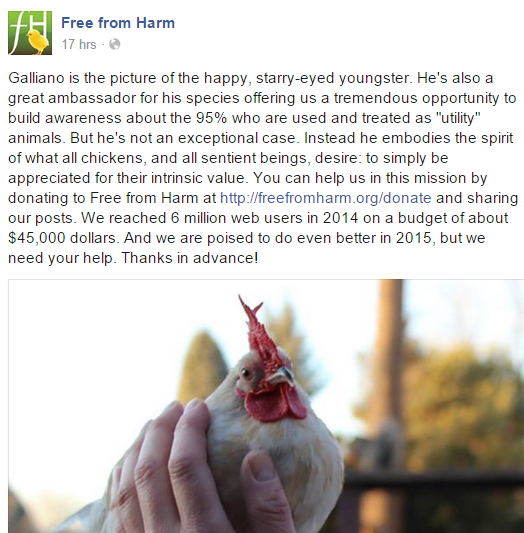
Free From Harm Facebook Post: "Galliano is the picture of the happy, starry-eyed youngster. He's also a great ambassador for his species offering us a tremendous opportunity to build awareness about the 95% who are used and treated as "utility" animals. But he's not an exceptional case. Instead he embodies the spirit of what all chickens, and all sentient beings, desire: to simply be appreciated for their intrinsic value. You can help us in this mission by donating to Free from Harm at http://freefromharm.org/donate and sharing our posts. We reached 6 million web users in 2014 on a budget of about $45,000 dollars. And we are poised to do even better in 2015, but we need your help. Thanks in advance!"

While I was not able to access the 2014 records, 2013 records are publicly available. In 2013, Free From Harm pulled in $92,000 from a grant, and only $20,000 of that was spent on social media outreach and web fees (the only major expenditure listed). About $70,000 was leftover in cash, savings, and investments. 

Given that billions of Nonhuman Animals like Galliano are desperately in need and could be hugely benefited if that surplus was unlocked, why not spend it? Why sit on the profits? Why am I being asked to donate when Free From Harm has more money than it can use? 

In fact, many non-profits hoard their income in this way. Non-profits act according to a capitalist logic of economic growth whereby bigger is thought to be better. Like most non-profits, Free From Harm likely hopes to achieve the status of Farm Sanctuary or PETA. Getting to that size will necessitate offices and paid staff. Interestingly, Free From Harm was not long ago crowdfunding in advocacy spaces looking for donations to support a salary for one of their volunteers. This occurred in spite of evidence in the 990 IRS form indicating that the organization has several thousands of dollars on hand that are not being put towards outreach.

Non-profitization has its benefits, to be sure. Becoming a non-profit means access to these huge grants, salaried activism, free postage from the government, relaxed repression from the state (as a group must deradicalize and become transparent in order to achieve the privilege of non-profit status), and increased public presence which is helpful for dispersing claimsmaking, but also for bringing in more funding. But the focus on growth is expensive. 

Counterbalancing these benefits are the many costs to the group's goals and tactics. Free From Harm has been known to take some questionable positions on racism in the Nonhuman Animal rights movement, as well as ableism. Many professionalized non-profits are hesitant to take a stand against human oppression, as capitalizing on racism can be profitable to the group. Free From Harm also features many essays from famous welfarists who are regularly hostile to abolitionist advocacy. This is probably because the celebrity association is more important for traffic than abolitionist veganism. To be fair, I think it is amazing that an education-based vegan group was able to land such a large grant. I do worry, however, that the logic of growth will undermine these goals as Free From Harm (and other groups like it) climb to the top.


A final point. The commodification of advocacy is a growing trend in social change spaces, and one that should be seriously reevaluated. In a heavily non-profitized social movement, meaningful, engaged, collective action is rarely engaged. Instead, calls to action are merely replaced with calls to donate. This serious squandering of advocate energy and people power is perhaps the greatest cost of all.

Thursday, March 5, 2015

Reining in the Elephants: Thinking Critically about Single-Issue Campaigns


Before I begin this article, I want to start out by saying that I am happy for the handful of elephants who will never again step foot in a Ringling Bros. and Barnum & Bailey Circus. But for the remaining elephants who will continue to be exploited in the circus's "conservation" facility, the camels that are being added to the show to take their place, and the billions of animals who have been snubbed by the Nonhuman Animal rights movement as activists rally around charismatic species like circus elephants while ignoring the importance of veganism, I continue to mourn. Not to rain on the parade, but it is at this time we should give pause and think critically about our tactics and goals.

The first thing that strikes me about this "victory" is how it is being handled by the circus itself as a means to improve their image and improve sales. The circus corporation writes:
This is the most significant change we have made since we founded the Ringling Bros. Center for Elephant Conservation in 1995. When we did so, we knew we would play a critical role in saving the endangered Asian elephants for future generations, given how few Asian elephants are left in the wild. ...This decision was not easy, but it is in the best interest of our company, our elephants and our customers.
Gosh, if I didn't know any better, I'd say this circus is the elephants' best friend! This process is known as "humane-washing." It happens when a company uses the rhetoric of "humane" to increase sales and public comfort with their inherently problematic product. This is not unique to the circus. Consider the following excerpt from Eco-Business: A Big-Brand Takeover of Sustainability (2013) by Peter Dauvergne and Jane Lister. Walmart and other large companies that profit from suffering are:
[ . . . ] taking over the idea of sustainability and turning it into a tool of business control and growth that projects an image of corporate social responsibility [ . . . ] 
[It is] proving to be a powerful strategy for corporations in a rapidly globalizing economy marked by financial turmoil and a need for continued strategic repositioning. It is also enhancing the credibility and influence of these companies in states, in civil society, in supply chains, and in retail markets. And it is shifting the power balance within the global political arena from states as the central rule makers and enforcers of environmental goals toward big-brand retailers and manufacturers acting to use "sustainability" to protect their private interests." (p. 2)
We must be suspicious when a company appears to be appealing to customer demands for a "humane" or "sustainable" product when the business itself continues to profit from the exploitation of the vulnerable. By taking the initiative, the corporation retains the power to define both the problems and the solutions. It is infinitely wiser for the corporation to act first to superficially address ethical concerns before the state steps in to create those definitions for it. What does it mean when corporations like Barnum & Bailey are in charge of "liberation" and "conservation"? Customer concerns are placated, future restrictions from the state are avoided, and the strategy actually becomes marketable.

Customers and activists alike can feel good about the circus now. However, as with many corporate-driven attempts to improve ethical problems, the improvements tend to be relatively meaningless and hide continued issues. Abolitionist project "My Face is On Fire" (MFIOF) reports on the new home for the "liberated" elephants:
This center is basically a breeding and training center. They loan out elephants and/or provide sperm to zoos so that they can stay well-stocked with elephants for their own customers. The Center has been criticized repeatedly for being a dreary place for the elephants. It's sometimes been called the elephant equivalent of a puppy mill. So how is this a victory for the elephants?
Even PETA calls bullshit. The "conservation center," Newkirk insists, is a for-profit enterprise that continues to hurt elephants under the guise of charity and with all of the benefits that a true charity might receive in the form of government and public support.

Ultimately, this is the corporation taking matters into its own hands to capitalize on the public's concern for animals in order to rebrand itself as "humane" and "sustainable." Make no mistake, this circus continues to enslave and exploit many other species. But as non-animal acts like Cirque du Soleil seem increasingly modern and fresh, and Ringling Bros. and Barnum & Bailey seem more like archaic and outdated relics of the past, the organization knows that riding the wave of the "humane" movement will be good for business. Of course, dumping animal acts altogether is likely not an option, as the corporation is well aware that the public still sees Nonhuman Animals as objects of resource, and animals sell. Elephants bad. Camels good. This moral inconsistency is thanks in part to the Nonhuman Animal rights movement that has always prioritized "special" species and ignored vegan education efforts. MFIOF continues:
Members of the general public will probably fall all over themselves to rush to the circus over the next three years to get "one last chance" to see the elephants go through the motions they've had hammered into them by their "trainers". When they're gone, they'll no doubt breathe a collective sigh of relief (after all, elephants are like land dolphins or giant baby seals) and then feel "better" about continuing to support the circus once they're gone. After all, animal advocates are cheering, aren't they?
Retiring elephants is a corporate strategy to dilute activist pressure and improve customer confidence in their brand
So what sort of victory are we celebrating here?  Instead of embracing a consistent, holistic vegan-centric message of liberation, the movement has irrationally focused on a few popular species, succeeded in moving elephants from one prison to another, and made a wide open space for the new camel act. For that matter, activists may have had little to do with the so-called "victory" at all. Barnum & Bailey is on elephant conservation like Walmart is on organic veggies.

If single-issue campaigns are so limited in their impact, so dependent upon unethical corporate interests to succeed, and so expensive in the resources they require, why engage them at all? In response to the "victory," T.O.F.U. Magazine writes:
Yes, there's more to be done, but everyone needs to know that progress is possible. 
That, I believe, is one of the main reasons that single-issue campaigns are engaged: for activist morale, not for effectiveness in the grand scheme. Activist morale is, of course, important to sustain a movement, but when the psychological needs of human activists surpasses effective strategy, it is time to get critical about what tactics we are choosing and why.

The Abolitionist Vegan Society writes:
Brace yourselves, abolitionists. Here come the "Victory!" (fundraising) emails from the nonabolitionist orgs because of the Ringling Bros. news.
Indeed. Perhaps even more important than upholding morale, single-issue campaigns are tools for fundraising. This is a point I explore in an article published in the academic journal, Food, Culture & Society (please email me for a full text copy if you are interested).  Again, this is less a matter of effective liberation strategy, and more of a matter of financial sustainability. Campaigning to reform or abolish "low hanging branches"--those social problems 99% of the public already agrees with, problems that generally pertain to "popular," "cute," or "majestic" animals--means that a social movement organization can count on easier access to resources. Again, it is important to take a serious look at our priorities. Are we a movement that seeks to capitalize on the public's preexisting pro-animal attitudes? Or are we a movement that seeks to challenge society's entrenched speciesism?

Decades of protesting, millions of dollars spent, and we've "succeeded" in shuffling elephants out of the circus ring and into a for-profit "breeding" center to the effect of improving the Ringling Bros. brand name. What if we'd put those resources into vegan education?


To summarize:

  1. Single-issue campaigns are generally a failure in disguise as they appear to abolish one form of oppression, but ultimately only make room for the increased oppression of others, or the oppression is simply transformed (in this case, elephants go from one jail to another, and tigers, dogs, camels, etc. will fill their space on the circus floor)
  2. Single-issue campaigns aggravate the irrational and speciesist compartmentalization of certain acts of animal oppression as especially "bad," while making invisible the higher-impact forms of animal oppression (like animal food consumption, the institution of domestication, etc.)
  3. To remain competitive, corporations will adopt superficial "humane" or "sustainable" measures to improve their brand image and increase sales
  4. Single-issue campaigns are low-impact for liberation, but beneficial for sustaining activist morale
  5. Single-issue campaigns are low-impact for liberation, but high impact for mobilizing resources
  6. Activists should consider whether or not capitalist growth is either necessary or congruent with a goal for achieving social justice (in other words, can capitalism solve our problems? Can we buy the revolution?)
  7. Activists should consider if their need to feel effectual is more important than actually being effectual 
  8. Vegan education may be less "exciting," but it is a higher impact form of low-cost activism that addresses all forms of oppression and avoids the problematic task of ranking which species and which forms of oppression are more important (decisions that ultimately lie on speciesist human preferences)
UPDATE 03/07/2015:  It appears that the circus's decision to cut elephants from the show also had a lot to do with the high levels of tuberculosis that are difficult to control among exploited elephants. Again, this is not a victory, this is a business move. 


Defending Non-Abolitionism Bingo Card

From my good friends at The Abolitionist Vegan Society . . .


There is a social psychological tendency for us to assume that because something exists or predominates, it must be good and most appropriate. Challenge yourselves and others to think critically and to value evidence before supporting a position. Remember, ad-hominems are not valid arguments; neither is it valid to accuse vegans of hurting the animals for daring to disagree. 


Wednesday, March 4, 2015

Mobilizing Anti-Muslim Sentiment "For the Animals"

Trigger Warning: Post contains discussions of racism against Muslims and the Nonhuman Animal rights movement's role in promoting it.

Anti-Muslim protests in the U.K.
The hatred of and discrimination against all things Muslim is a social justice issue that is especially poignant in today's post-911 world where many live in fear of the latest reports on ISIS and few understand the complexities of Middle Eastern current events. In the West, the ubiquitousness of hate crimes against Muslims or anyone who "looks" Muslim makes life unsafe and unfair for many. Even the KKK is on board. The Huffington Post reported earlier this week that Ku Klux Klan literature has been promoting increased discrimination against Muslims.

Unfortunately, it doesn't end with hate groups. The Nonhuman Animal rights movement itself has a long history of mobilizing racist sentiment in order to garner support for Nonhuman Animal protection. True, many of the early activists were active in the anti-slavery abolitionist movement, but it is also true that many early rights and welfare laws specifically targeted communities of color at home and abroad in the colonies. In some ways, this was an act of deliberate racism, but movements also make "compromises" by pulling on racism to increase resonance.

Muslims in particular have routinely been the target of Nonhuman Animal rights activism, specifically in regard to slaughter practices. "Live export" campaigns go back at least as far as the 1980's, with organizations demonizing Muslim regions for their "barbaric" treatment of livestock sourced from Western countries. In my research, for instance, I have uncovered reports produced by direct action advocates in the U.K. who had been protesting live export, only to have Compassion in World Farming take credit for their activism without even being present at the protests.

Compassion in World Farming, "the world's leading farm animal welfare organization," continues to benefit from racist campaigning today. In a newsletter released today in promotion of their "The Secret is Out" campaign against Muslim slaughter, CIWF invites us to "Expose the Truth" by supporting their campaign, specifically, by donating and signing a petition.

From the CIWF newsletter: EXPOSE THE TRUTH I've got a secret to tell you. And I need your help to expose it. When we received a tip-off about a hidden trade in European farm animals we knew we had to find out more. But to do that our Investigation Unit had to visit one of the world’s most volatile border crossings, the Israeli‑controlled Kerem Shalom border, where the Gaza Strip, Israel and Egypt converge. They brought back some shocking evidence, which I’m sharing with you today. What they found was a trade in cattle, transported from the EU, being sent alive into war-torn Gaza to be slaughtered. They tracked down animals who had travelled thousands of miles by land and sea from Romania and Hungary – via Israel – to Gazan slaughterhouses where, frankly, it just isn’t possible to slaughter an animal without causing immense suffering.

Please note the following statement from the above excerpt which I have found to be especially problematic (emphasis mine):
They tracked down animals who had travelled thousands of miles by land and sea from Romania and Hungary - via Israel - to Gazan slaughterhouses where, frankly, it just isn't possible to slaughter an animal without causing immense suffering. 
This language implies that Muslims living in Gaza are inherently incapable of anything but cruelty. This statement also wrongly implies that killing Nonhuman Animals can be done without suffering. By contrast, readers are left to assume that 1. killing can be done "humanely," as long as it is 2. done by the "right" people in the "right" places. The language of "exposing the truth" and the "secret is out" also, I believe, pulls on Western conceptualizations of Islamic terrorism. CIWF frames their campaign as though the underground, clandestine evil of Muslims in slaughterhouses is being "leaked" to the public, who can now use that knowledge to intervene in the name of justice.

And what of the immense human suffering taking place in Gaza? Suffering brown bodies don't sell. CIWF relies on graphic images of animals being murdered and the societal hatred of Muslims in the West in order to promote their campaign. I charge that such an approach is morally problematic in that it diminishes the integrity of Nonhuman Animals whose suffering becomes a selling point, and it diminishes the immense human rights violations taking place against Palestinians living in Gaza. Indeed, the violence against humans taking place in Gaza is made invisible.


Nonhuman Animal rights campaigners should not be in the same business as the KKK. There is no justifiable reason to target vulnerable groups for their seemingly more horrific use of Nonhuman Animals, especially when the West engages in a number of equally horrific acts of violence (including the failure to protect Palestinians). This is not done by accident: Nonhuman Animal rights organizations know that by targeting the activities of wealthy whites in the West, they are not likely to garner as much support as they might by targeting poor brown people in a war-torn region. It is easy to demonize them, because the rest of the world is already doing the same.

Compartmentalizing violence against other animals is morally problematic for a number of reasons. The tendency to vilify the practices of vulnerable human groups while ignoring the practices of those in power is one of those reasons. To avoid fanning discrimination, it is best that we promote a holistic vegan position. Cows in slaughterhouses are no more deserving of protection than any other species oppressed by humans, and slaughterhouses in Gaza are not measurably worse than many in the United States. Creating a hierarchy of concern only replicates systems of inequality and systems of privilege. Until we situate our vegan message within an intersectional framework of social justice, we will remain a marginalized movement that few take seriously.

Thank you to Sarah Woodcock of The Abolitionist Vegan Society for bringing this campaign to my attention.