
Showing posts with label Gender. Show all posts
Showing posts with label Gender. Show all posts
Friday, April 3, 2015
Corey Wrenn featured on Under the Toadstool

Thursday, March 26, 2015
Should We Troll Tom Regan?

For women like myself with an active and public presence on the internet, we are fully aware that we "set ourselves up" for abuse by simply being present and by having an educated opinion. Women are expected to be silent and invisible. For those who dare to disobey these gender norms, retribution is swift.
Whenever I publish something critical of violent tactics, I can expect a fresh onslaught from advocates who are violently opposed to my stance against violence and are dead set on "teaching me a lesson" or shutting me up. Female colleagues who share my work sadly experience similar punishment. It is unfortunately lost on many that aggressive retaliation of this kind is also a form of violence, especially when it is directed at women and relies on scripts of sexism.
The thing is, a number of male-identified leaders in the movement are quite outspoken about illegal or violent direct action. Tom Regan, for instance, regularly publishes and lectures on the problems with violence in the name of Nonhuman Animal liberation. Indeed, an entire chapter of Empty Cages (2004) chastises violent advocacy. How can it be that Regan and other men like him can contribute ideas so freely?
First, retaliation against women who are critical of violence tends to reflect gender policing. That is, a male-led movement will turn on women who challenge patriarchal norms in order to push them back into their proper feminine roles of subservience and silence.
Retaliation also reflects a general devaluation of femininity. While men can be opposed to violence as well, we recognize that aggression and violence is associated with masculinity, while peace-making and non-violent, inclusive, education-based advocacy is associated with femininity. Therefore, when male activists gang up on women speaking out against violence, they're actually reacting to their discomfort with (and even disdain for) feminist politics and women's power.

Tom Regan is our great movement patriarch, so going for his jugular over his anti-violence position seems unthinkable. We pay deference to men, but we distrust women. Male leaders and activists get to disagree and still have their positions relatively respected. Men's ideas get full consideration; women's get tone-policed. Men are acknowledged as equal participants; women's motives are questioned. For women who speak out, there will be a price to be paid.
Though some male-identified activists surely do face a good bit of criticism, we do not inhabit a post-gendered society. What this means is that men and women will not be criticized similarly, and the consequences of that criticism will not be comparable. Male privilege will always buffer the blow.
Until direct action advocates are prepared to blast Tom Regan with trolling and sealioning with the same ferocity that female activists experience, we must recognize this for what it is: sexism.
First, retaliation against women who are critical of violence tends to reflect gender policing. That is, a male-led movement will turn on women who challenge patriarchal norms in order to push them back into their proper feminine roles of subservience and silence.
Retaliation also reflects a general devaluation of femininity. While men can be opposed to violence as well, we recognize that aggression and violence is associated with masculinity, while peace-making and non-violent, inclusive, education-based advocacy is associated with femininity. Therefore, when male activists gang up on women speaking out against violence, they're actually reacting to their discomfort with (and even disdain for) feminist politics and women's power.
Though some male-identified activists surely do face a good bit of criticism, we do not inhabit a post-gendered society. What this means is that men and women will not be criticized similarly, and the consequences of that criticism will not be comparable. Male privilege will always buffer the blow.
Until direct action advocates are prepared to blast Tom Regan with trolling and sealioning with the same ferocity that female activists experience, we must recognize this for what it is: sexism.
Wednesday, December 3, 2014
Cork Vegans, Misogyny in Ireland
TRIGGER WARNING: Contains rape meme and dismissive comments about violence against women.

On World Vegan Day, Cork Vegans announced they would use the holiday to promote LUSH by leafleting outside the Cork store, encouraging people to buy their products (sort of like Avon representatives, they would receive a portion of the proceeds). But, LUSH is a non-vegan company that routinely (and intentionally) uses images of violence against women to shame or scare them into buying their expensive soaps and bath bombs. When I raised some concerns with the group's decision to squander a day of peace and non-violence on a non-vegan company that causes violence to both women and other animals, the group administrator responded that it was "women's choice" to participate in sexist demonstrations and that LUSH is worth supporting because they are "kind and generous" (to whom exactly?) and "their products are not animal tested." On World Vegan Day, the last thing I want to do is promote a non-vegan company that hurts women, so we stayed in and I began compiling my social psychology series on vegan outreach. Unfortunately, these essays are probably not of much help to vegan groups that focus their energy on capitalist consumption.
This morning, Cork Vegans posted a crude Vegan Sidekick rape meme that uses violence against women as a metaphor for violence against other animals. Vegan Sidekick is notorious for exploiting the imagery and language of violence against women to discuss Nonhuman Animal rights, completely disregarding the fact that we live in a rape culture and violence against women is a real and lived experience for half the human population. Perhaps this is intentional. Activists and organizations realize that women are considered subhuman--there is no concern in upsetting or triggering them, because women's feelings and experiences simply don't matter under the patriarchy. When the movement endangers women and dismisses women's concerns, but then uses women's experiences to promote their cause, this is known as tokenizing. For more information on the problematic nature of trans-species analogies that tokenize and exploit, what Kim Socha calls "fast food activism," please read my earlier essays, "Rape as an Anti-Speciesism Tactic and the Vegan Male Discourse" and "The Misogyny of Animal Rape Imagery."

 |
| Cork Vegans: "I'm not going to apologise for sharing this. If you don't like the posts on this page just 'unlike' the page or remove it from your newsfeed." |
Cork Vegans' response?
I'm not going to apologise for sharing this. If you don't like the posts on this page just 'unlike' the page or remove it from your newsfeed.
Let me be clear, when women are told, "If you don't like it, keep it to yourself/don't look/go elsewhere/unlike," the message is clear: your victimization does not matter. When activists say, "I'm not going to apologise" for hurting vulnerable people (rape victims in this case), what they are also saying is: we intend to protect our oppressive structures and don't care who it hurts. Telling survivors to "unlike" violent material in their own community is dismissive. It is also complacent and oppressive.
It's also a form of victim-blaming. It is though it is women's fault for being exposed to the movement's misogyny. It's women's fault for participating in the movement. It's women's fault for existing. What an unwelcoming position to take. Society already maintains intensely powerful systems of victim-blaming that successfully silence most rape victims. Silencing survivors in our movement as well is nothing short of repulsive. Why would anyone want to join a movement that behaves in such a way to vulnerable people?

Promoting and abetting violence against women "for the animals" is grossly unethical, dangerous, and it absolutely does not work. If misogyny as a tactic doesn't work, then why engage it? I believe it is because this is behavior that works in tangent with patriarchy. People hate and hurt women because that is what they've been socialized to do; this goes for men and women. Even activists in the service of peace will prey on the vulnerable, because it is a script that we are all taught from infancy.
Cork Vegan's actions have been extremely triggering for me. As a result, I want nothing to do with the group. I would never feel comfortable being around them, much less supporting them. My experiences with Cork Vegans and other sexist groups in the movement have got me thinking: if I can barely put up with it, how could (and why would) anyone else put up with it? Because my career involves studying and researching in the Nonhuman Animal rights movement, I cannot disengage, but I can only imagine how many thousands of people the movement turns away with its callous, violent behavior.
The dismissal of human suffering is a political problem for our movement. It aggravates oppression, and paradoxically so since we claim our goal is to end oppression. It doesn't make sense, and it doesn't work. When groups like Cork Vegan engage this violence and then respond to criticism with "don't look" or "go somewhere else," that is exactly what most people will do.
Update 12/4/2014: Cork Vegans responded several times to inform me that my colleagues and I are "a bunch of IDIOTS," "CRACKPOTS, and "off our heads." This response indicates that they are unable or unwilling to reflect on the misogyny they facilitate, are intent on aggravating misogyny with more hostility and victim-blaming, and that they are also extremely disableist. I would advise women and other vulnerable groups be wary of this organization and others like it, they can be quite volatile.
Update 12/4/2014: Cork Vegans responded several times to inform me that my colleagues and I are "a bunch of IDIOTS," "CRACKPOTS, and "off our heads." This response indicates that they are unable or unwilling to reflect on the misogyny they facilitate, are intent on aggravating misogyny with more hostility and victim-blaming, and that they are also extremely disableist. I would advise women and other vulnerable groups be wary of this organization and others like it, they can be quite volatile.
Sunday, June 22, 2014
Seeing "Euthanasia" as an Extension of the Capitalist Project
Oftentimes we explore the problem of “euthanasia” (generally
a euphemism for the killing of healthy dogs and cats) as a basic matter of morality
or rights ethics. I argue that we should also be exploring this as an extension of
anti-capitalist efforts as well. Norm Phelps has
argued that the dog and cat industry is a capitalist one, with consumers
encouraged to purchase designer dogs and cats and to dispose of them when trends or lifestyles change. “Shelters,” he argues, are to the dog and cat
industry as the landfill is to other material goods. Shelters exist to dispose
of unwanted dogs and cats who are continually produced, consumed, and disposed
of in a constant capitalist cycle. Euthanasia is an essential component to capitalism.

The arguments for euthanasia are really quite disturbing in
this light, especially given similar projects designed to eliminate unwanted
human populations that are a burden on the capitalist treadmill. I have heard
it argued that not killing dogs and cats waiting on homes is “a waste of people’s
time and money.” Ironically, I saw this
argument made in an anti-capitalist animal rights space. But this is the very logic
of capitalism, that is, to view sentient beings as disposable objects measured by their monetary
value. Strange, when it comes to privileged groups, where there's a will, there's a way. When it comes to devalued groups, killing is just "common sense."
When a sentient being is deemed a burden to the capitalist
system, that sentient being becomes extremely vulnerable to suffering and
death. Recall Jonathan Swift’s satirical essay A Modest Proposal for Preventing
the Children of Poor People from Being a Burden to Their Parents or Country,
and for Making them Beneficial to the Public, which suggests that the
burdensome poor Irish could be repurposed for wealthy persons . . . killed and
served up as food.

Consider also “overpopulation” rhetoric which is promulgated
by wealthy Western nations who see the masses of poor in third world countries
as a burden on the capitalist system (similar programs have targeted poor women of color in the United States as well). “Population control” efforts invariably
target vulnerable poor persons, usually brown, and usually women. These efforts are intended to annihilate entire
groups of people—masked as “family planning,” they are often dangerous, non-consensual,
and life-threatening.

The notion that vulnerable
groups can be “euthanized” or “controlled” “for their own good” (a position held by privileged groups), that euthanasia is a "rational" matter to save “people’s time and money” is the language of oppression
. . . capitalist oppression. We should be critical of this line of
thought. It won’t get us any closer to
liberation. It only normalizes exploitation and objectification.
Saturday, May 24, 2014
White Male VegFest Colorado: Gatekeepers & Institutional Discrimination in the Animal Rights Movement

As I am in Colorado for the summer with fellow vegan feminist Cheryl Abbate, we’ve been keeping an eye on the vegan community, looking for fun stuff to do. I haven’t been to a “vegfest” of any kind since I was a teenager, and Cheryl thought it might be fun to check out VegFest Colorado 2014. But then we took a look at the speaker schedule: Andrew Freeman, Andy Mars, David Robinson Simon, Jeffrey Smith, Marc Bekoff, Paul Shapiro, Virginia Messina, and Will Tuttle. Notice anything strange about this lineup? Seven out of 8 are males…white males at that. Ick.
Others took notice as well on the event’s Facebook page. Sadly, faced with comments on this blatant reproduction of male privilege in the animal rights movement, the organizers simply accused concerned persons of being sexist, misandrist, trouble-making, ingrates that ruin things “for the animals.” The inevitable tone-policing (a favorite tool of oppressors for deflecting blame and dismissing injustice) reared its ugly head. Because if marginalized oppressed people dare make a peep about equality, they better ask nicely and quietly with a pretty please at the end.
The very notion that feminists raising concern about the almost completely male panel of speakers (in a movement that is notoriously sexist) could ever possibly be sexist themselves is amazingly laughable. Under a patriarchy, men cannot be victims of sexism–this is because the institutions of patriarchy are designed to privilege men. This “reverse sexism” trope is a common fallback for sexist groups in the movement, and I am starting to feel like a broken record.
Furthermore, as I explain in an essay I published last year, lamenting “the animals” is a distraction technique meant to falsely reverse victimization. It takes the blame away from those responsible for the problem (almost always persons of privilege) and puts it on the individual drawing attention to the problem (usually marginalized persons). It’s a technique designed to avoid cognitive dissonance and protect structures of inequality. In that essay I explain:
Emphasizing the urgency of Nonhuman Animal suffering (“RIGHT NOW!”) is meant to distract. No time to think, animals are suffering! This trope is invoked to silence criticism and maintain the status quo. Plain and simple.People using this trope are exploiting the torture and death of Nonhuman Animals to maintain privilege and inequality. Why are you upset about the rape culture animal rights community perpetuates? Animals are suffering RIGHT NOW!
The point of frustration comes from the relentless inability for important gatekeepers in the Nonhuman Animal rights movement to accept responsibility for institutional discrimination. Let me be clear: very few persons today are explicitly sexist or racist. Most individuals today engage in implicit or unconscious prejudice and stereotyping; most of us outwardly hold egalitarian ideals. This is great news on one hand, but on the other, it makes challenging the barriers that remain all the more difficult. Much of the problems facing marginalized groups today result from institutional barriers. This is the culmination of subtle prejudices and discriminations and the cumulative effects of many centuries of state-supported institutionalized discrimination. So, even if we personally don’t feel we are sexist or racist, that does not mean sexism or racism doesn’t exist.
And yet, we are so quick to individualize the problem: “It’s your problem for finding a problem. I’m not sexist. In fact, you must be sexist for suggesting such a thing!” But sexism (and other forms of discrimination) do exist; and culpability must fall somewhere.
In many studies of institutionalized barriers, institutions, organizations, corporations, groups, etc. are often quick to pass the blame. They would love to be more diverse…if only they had more diversity to choose from! For instance, when faced with the gross gender inequality in academic departments, professional associations often merely blame women: not enough women are interested in the field. When publishing companies have been accused of publishing too few African American authors, it’s not their fault, people of color just don’t like to write as much as white people! When companies using sexist advertising are called on their objectification, it isn’t their fault, that’s what the consumers want. Why no women in VegFest Colorado? Not their fault; it’s just men are easier to get! No women signed up!
This is individualizing a systemic problem. Instead of institutions of considerable privilege recognizing their role as gatekeepers, the incredible power they wield in improving representation, and the important role they play in setting standards and values for their audiences, these groups merely blame the already marginalized communities.
In another essay I’ve posted for Vegan Feminist Network on how to be a good male ally–I think it is also essential for men to start taking responsibility for sexism in the movement and use their privilege for good instead of status quo. Men need to speak up about this. Powerful men (like Marc Bekoff and Paul Shapiro) should withhold their services until the diversity is improved. The animals aren’t missing out–the only persons who would miss out are the men who benefit from the celebrity involved in these events. Indeed, the atheist movement has had a similar problem with few female speakers at important events–but the atheist movement has significantly less women to begin with, and they have been able to push back with boycotts and all-female conferences. If the horrifically sexist Free Thinking movement can start making progress on this front, surely the mostly female animal rights movement can do the same.
In a movement that is 80% female, there is no excuse for an all-male or nearly all-male panel of speakers/group of contributors.Of course the problems with diversity at major events is not only a matter of gender equity. The overwhelming whiteness of activist pools and events is an indicator of something much more disturbing that has manifested in our movement. But the majority of our movement is already female, and we can’t even ensure equal representation for women? This should be a serious wake up call.
At the end of the day, I am of the position that these events tend to be colossal wastes of precious few resources (as a matter of animal liberation at least). I recognize that creating community is essential to preserving vegans, but I wouldn’t say this is exactly “for the animals.” The majority of event goers I suspect are not going to be uninitiated people waiting to be converted, they will be people who are already “converted” and looking for something to do like Cheryl and I. These events are nothing more than sites of fundraising, personal entertainment or gain, and celebrity worship. This isn’t “about the animals,” it’s about us. Especially for events that are geared towards encouraging community, we need to take responsibility for the discrimination being reproduced there. A movement that belittles and trivializes the marginalization of human groups will be unwelcoming and ineffective for other animals. End of story.
Originally posted on Vegan Feminist Network.
Saturday, April 26, 2014
Review: Social Lives with Other Animals
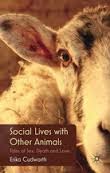 You may have to be a real theory junkie to enjoy this book! I must admit, I found the first couple of chapters trying--I believe most would probably not be interested enough to continue(This is why I did not give the book 5 stars). Thus far, though, this is one of the most (if not the most) comprehensive sociological texts on human and nonhuman relationships. Most of the book is a review of the literature, exploring the fields of post-humanism, human animal studies, animal rights, and ecofeminism. I would not recommend this book for a beginner--this book is best suited to A) professionals or graduate students already in animal studies fields who are interested in the sociological literature on other animals or B) Sociologists interested in learning what the discipline has to offer species studies. I believe her intended audience is likely the latter, as there is a lot of effort put into explaining the living conditions of animals that would be well understood by those already studying animal issues. Indeed, while Sociology has historically been extremely exclusionary when it comes to other animals (a frustrating short sight given the emancipatory/critical nature of the field), Cudworth is able to ground the growing interest in animal studies in a rich(and interdisciplinary) body of work from contemporary Sociologists all the way back to the founding theorists(Marx, etc.).
Again, the first chapters are primarily a review of the literature, but the meat of the book unpacks important concepts in speciesism. Chapter 4 covers the important gender variable in our relationships with other animals based on the work of Carol Adams. Though he is not referenced, Brian Luke's theory of masculinity and animal violence is heavily evidenced in her discussion of gendered foodwork and animal industry. Chapter 5 offers an overview of the institutionalized violence animals endure. Chapter 6 makes the case that humans and other animals have meaningful relationships. She explores this with an ethnographic study of human-nonhuman communities that form around dog-walking.
As with any social scientist worth paying attention to, she grounds her theory in emancipatory anti-speciesist practice. She extends quite a bit of effort criticizing some prevailing positions that, on the surface, may seem to be critical of speciesism, but ultimately make serious exceptions for continued oppression (so long as that oppression is made "nicer"). Cudworth introduces the concept of an "anthroparchy" to specifically view our relationship with other animals as a system of domination, oppression, and marginalization. Speciesism is not so simple as a mere prejudice for other animals--it is a historically situated project of human supremacy and animal exploitation. It is a system that benefits humans at the expense of vulnerable nonhuman animals. Addressing this system means ending this system, not reforming it.

A side note--something I couldn't help but take issue with--she mentions that Gary Francione is rightly critical of reform approaches. However, she claims that he incorrectly has faith in law (and, thus, the state) in liberating other animals. I think this is a mischaracterization of his approach. She is right to say that he is critical of the law as it stands, but Francione believes that grassroots bottom-up vegan education that attacks speciesist ideology is the preferred strategy (and he is extremely critical of legal campaigns that seek to improve laws for animals). Francione operates according to a simplistic "supply and demand" logic that supposes that 1. Attacking speciesist ideology with vegan education and 2. Increasing vegan numbers to create a critical mass will 3. Dismantle speciesism. Nibert's approach is probably a better criticism to Francione's work in this regard, as Nibert places more emphasis on the inherent oppressiveness of the capitalist system. Most Sociologists agree that a capitalist state will always be oppressive. Francione seems to think that capitalism can work in favor of animals if we replace non-vegan industry with vegan industry. Perhaps this is what Cudworth was hinting at in her criticism, but her exploration into Francione's approach did not exceed more than a couple of sentences. Francione certainly isn't making the case that we look to the state to save animals. Indeed, he is highly critical of state institutions, bureaucracy, and hierarchy. However, Francione seems to think that the economy reflects ideology, but Sociology argues the opposite--ideology (and institutions) reflect our economic mode of production. Therefore, any attack on speciesism must also be an attack on capitalism.
Because this book is terribly dry at times (as it is basically an extensive summary of theory), I would not recommend it to the lay reader, but would probably suggest David Nibert's work instead or at least read them together. Nibert's work makes very similar arguments but is written in a more engaging way. Cudworth's book is probably best reserved for the serious academic or researcher. On the other hand, Cudworth's nuanced discussion of gender, foodwork, and animal exploitation, however, (heavily influenced by Carol Adams' sexual politics of meat) is an important extension on Nibert's work.
All in all, a very useful addition to the growing Sociology of critical animal studies. Worth having on the shelf as an excellent resource and reference to the field. If you want to learn the sociological position on animal oppression--this is the "go to" text. For seasoned Sociologists, Cudworth's case for the inclusion of species politics is remarkably solid--I can't imagine any social scientist walking away from this book unconvinced. Nonhuman animals are part of our lives and part of our social world. We form relationships and communities with them. We benefit from them. They structure our reality. They also exist within systems of oppression in much the same way that vulnerable humans do--a relationship of violence that we have a moral obligation to recognize.
Friday, March 21, 2014
PeTA Perpetuates the Sexual Politics of Meat and Classism in their Most Recent Pokémon Parody Game
By Stevie Lynne
PeTA released their latest Pokémon parody game, Pokémon Red White and Blue, in late 2013. PeTA have a very valid criticism of Pokémon in so far as Pokémon reflects and perhaps reinforces the speciesist idea that nonhuman animals are ours to use. However, there are a few things I wish to specifically focus on in their new parody, namely classism, sizeism and sexism.
Their latest parody game is loosely a sequel their earlier game Pokémon Black and Blue, a parody of versions Black and White. The aesthetic of PeTA's most recent parody game mirrors the first: all the scenes are dripping with obscene amounts of blood. PeTA's acceptance of and indeed over-top violence in this game warrants its own article.
The story in Red White and Blue follows newly liberated Pikachu, identified by the broken shackle around his neck, bandages, and a chunk missing from his ear. The game opens with a cow-like Pokémon, Milktank, being beaten up by McDonald's mascot, Hamburglar. Hamburglar has slipped through into the Pokémon universe to capture Pokémon to use in McDonalds products. Pikachu
steps in, defeats Hamburglar and saves Miltank. Pikachu and Miltank then follow Hamburglar back to the real world where they discover that McDonald's is using cute Pokémon toys to sell animal products to children. Together, they find various people who are involved in exploiting animals and use physical violence to overcome these “enemies”.
While I agree vaguely with PeTA's critique of McDonald's as a corporation using manipulative advertising to indoctrinate children, there are several elements of this game that are intensely problematic.
The “Fat” McDonald's Customer vs. the “Attractive” PeTA Protesters
When the Pokémon first enter the “real world” they come across a McDonald's with a customer standing outside.

It's important to note that the McDonald's customer is portrayed as wearing ill-fitting clothes, is covered in food stains, and is also larger than the other characters depicted in the storyline. Here, PeTA are drawing on fat-shaming stereotype of larger people being slovenly and disgusting.
It's not as if PeTA aren't well known for being sizeist. Their 'Save the Whales' campaign remains one of their most offensive ideas to date.

To strengthen the association of the McDonald's customer being “gross”, after battling and defeating the McDonald's customer, the party encounters a group of PeTA protesters outside McDonald's. None of these figures has a similar body shape to the McDonald's customer. Jigglypuff even asks “Are you all so attractive?”

By inference, being larger, like the McDonald's customer is “not attractive”.
The Evil Slaughterhouse Workers – How PeTA Perpetuates Classism and Racism
Part way through the game, one of the enemies the liberated Pokémon encounter are two slaughterhouse workers. They are characterised by menacing facial expressions, wearing white coats, and carrying meat cleavers. They are splattered with blood.

The portrayal of slaughterhouse workers as being an evil enemy of Pokémon and animal liberation reeks of classism. In the United States, slaughterhouse workers are predominately poor people of colour, an unknown percentage of whom are undocumented and as such have limited access to workers rights (Source: Food Empowerment Project).

In addition, slaughterhouses are environments which are psychologically damaging to people as well as being horrific for nonhuman animals. One study in the United States looking at 581 counties discovered that “slaughterhouse employment increases total arrest rates, arrests for violent crimes, arrests for rape, and arrests for other sex offenses in comparison with other industries.”
In Australia, the Northern Territory has recently proposed a scheme for making prisoners work in a new abattoir opening up later this year, despite evidence that slaughterhouse work is psychologically damaging and leads to increased crime rates.
PeTA by setting up slaughterhouse workers as the enemy in this game clearly have no idea about ways in which structural oppression ensures that lower class, people of colour, undocumented migrants and even potentially prisoners, are forced to carry out psychologically traumatising work.
Slaughterhouse workers are not the enemy of the animal rights movement and it's ignorant to suggest that is the case.
Jigglypuff as Lettuce Lady and the Sexual Politics of Meat
One of the battle moves PeTA has designed for Jigglypuff is “Lettuce Ladies”. This is most certainly not a move present in the original games. When you execute this move, Jigglypuff turns to the camera, suddenly holding two lettuce leaves as a “bra” over her chest before lashing out at the opponent.

In Carol J. Adam's seminal text, The Sexual Politics of Meat, she defines the sexual politics of meat as “an attitude and action that animalizes women and sexualizes and feminizes animals.”
PeTA have done exactly that with the character of Jigglypuff.
Here Jigglypuff is clearly sexualised, drawing on the common and ineffectual campaigning technique by PeTA of placing women out in public covered only by lettuce leaves. But here Jigglypuff is supposed to be “liberated”, but is instead being sexualised as feminized object.
This type of gendering of the oppressed non-human animals as feminine in imagery often appears in animal exploitation advertising. For example:

But the vegan movement is no stranger to sexualising and objectifying women.
As Corey Wrenn has written: “The vegan movement also favors the tactic of turning women into consumable objects in the exact same way that meat industries do.” She also notes why this is problematic from a systemic level: “Instead of empowering women on behalf of animals, these approaches could be disempowering women by preserving a patriarchal framework.”
In the Pokémon parody PeTA do to Jigglypuff what the meat industry does to the bodies of animals. Just like this image of a sexualised pig, PeTA are repeating similar structural oppression of nonhuman animals:
 |
| Photos from Carol J. Adams' blog. |
Typical PeTA Tropes
Critiquing Pokémon for its reflection and potential promotion of speciesist values is a valid undertaking. Critiquing McDonald's for using cute Pokémon toys to manipulate children is also a valid undertaking. However, PeTA's latest Pokémon parody replicates similar oppressive structures as found in some of their other campaigns – including, but not limited to: sizeism, classism, and sexism.
PeTA is sadly a broken record, continuing in their contributions to oppression while all the while being the most well-known “face” of the animal rights movement.
Stevie Lynne co-hosts Team Earthling Vegan Radio, a weekly Australian podcast.
Sunday, March 16, 2014
Fat-Shaming, Sexism, and Other Horrors from the Tom Regan Archives
NOT SAFE FOR WORK: Contains sexually suggestive images and adult language.
Last November, I traveled to Raleigh, North Carolina to visit the Tom Regan Animal Rights Archive at North Carolina State University. I'm conducting a content analysis of animal rights literature from the 1980s through today for my dissertation. While I was specifically looking for evidence of factionalism between professionalized non-profits and the marginalized radical groups, I couldn't help but take notice of some really problematic ads, articles, and tactics. Enjoy these cringe-worthy finds from the Tom Regan vaults...
Professionalization
The exact moment when Compassion over Killing sold out. Earlier issues promoted radical activism and veganism. As CoK professionalized and became more dependent upon conservative funding, they switched to pricier glossy paper and vegetarian rhetoric.

Homeless-Shaming
Remember when PETA used to give away despoiled animal hair jackets to homeless persons? Far from altruistic, the intention was to damage the high status of "fur" by associating it with society's most undesirable and stigmatized. As you will see, PETA is pretty shameless when it comes to exploiting the vulnerability of marginalized groups for their gain.

Fat-Shaming
I can safely conclude that PETA has been promoting weight stigma for at least 20 years now. Thanks to PETA for their important public service announcement that undoubtedly spared thousands of fat people from spontaneous combustion.


I actually remember receiving this issue as a young kid, which is pretty sad. This is the last thing 13 year old girls need to be reading.
 |
| Weird. Someone want to explain to me how I gained 30 pounds in my 14 years as a vegan? |
 |
| If I had a pair of these sweet 90s jeans, maybe I'd have some incentive! |
Animalizing Women

 |
| The level of misogyny in this Friends of Animals advert is truly astonishing. |
 |
| Because institutionalized violence against animals, pleather suits, and masturbation are a logical combination. |
 |
| Animalizing groups to degrade and otherize them is kind of defeating the purpose, isn't it? |
 |
 |
| Ethics, health, saving the earth? Nah, the most convincing case for veganism is combating impotence. |

No, nevermind, more fat-shaming!
Reverse Sexism
... doesn't exist. Notice in the rare cases men are showcased, it is comical and rarely "sexy." This is because 95% of subjects who are sexually objectified are women, so when the roles are reversed, it is seen as so out of the ordinary it becomes funny.

 |
| Animal rights: Fighting patriarchy with patriarchy...PETA sells penis power over animal ethics. |

PETA's Misogynistic Obsession with Women Who Wear Animal Hair
...as though men don't wear shoes, jackets, belts, wallets, etc. made of cow's skin. We live in a patriarchy, so men don't make easy targets. Society already hates women and condones systemic violence against them, so anti-fur campaigns can cheaply cash in on misogyny.
 |
| Women are narcissistic and frivolous. |
 |
| Women are airheaded and ditzy. Here PETA awards a male reader for his astonishing skills in stereotyping women. |
Violence Against Women
Here, PETA frames their misogynistic obsession with women as a "war," offering readers "ammo" and "combat tips." Remember, women are the primary persons wearing animal hair. Homicide is also one of the leading causes of death for women. Millions of women are also stalked, beaten, and assaulted every year.
 |
| Todd Oldham the misogynist reminds us, 'If you were a mink about to be vaginally electrocuted, you wouldn't think of anti-fur activists as bullies." |
 |
PETA often draws on imagery of dead or maimed women to threaten women into compliance or to appeal to patriarchy. Most often, they are naked, nearly naked, wearing excessive makeup, or are otherwise posed in a sexual way. In a misogynistic society, sexualizing harm to women plays into familiar gender scripts that maintain male dominance and female subservience.
 |
| Women who wear "fur" risk fatal retribution. |
 |
| Because human corpses are buried naked...and nothing is sexier than a young naked woman than a dead young naked woman. |
 |
| The ultimate symbol of femininity merged with the ever popular imagery of bloodied women. |
 |
| Compassion over Killing suggests women who wear animal hair should be killed and used as rugs. |

Again, associating sexualized women with death.
 |
| I don't think cowgirls are vegan...nor do I think they would be very effective at their job in Daisy Dukes and giant sun hats... |
Monday, February 3, 2014
Framing Violence and Science: A Protest Goes Downhill Fast...or Does It?
My buddy and colleague Cheryl Abbate recently commented on an activist demo which involved several folks stalking out (or "staking out" depending on your perspective) the private residence of a female vivisector. Activists staged a silent vigil outside this woman's home, and a bunch of counter-protesters were waiting to greet them. The animal advocates maintained their nonviolence, but were screamed at and spit upon. Cheryl and others have been understandably shocked by the event, and because it was caught on camera, it offers an excellent opportunity for a little sociological analysis...

My first reaction to this event is to recognize that framing the animal advocates as "nonviolent" is not wholly accurate. These are people who have staked out a woman's private home. That is in itself a violent action. Vegan feminists, myself included, do not view this as a nonviolent tactic. Carol Adams has even recounted her own experience on the other side of a protest, as her home had been picketed once. It not only terrified her, but it terrified her children. You can read Marti Kheel's analysis of "direct action" by clicking here.
Violent tactics only continue to give us a bad name and support our negative stereotype. Tom Regan has identified this negative stereotype as one of the primary reasons why our movement has been stunted and fails to flourish (see Empty Cages). For that matter, this tactic represents your classic single-issue campaign. As I have argued before, single-issues are a waste of time and a waste of resources. They ignore the root of the problem, and they single out particular (popular) species at the expense of others. They also detract from vegan education. You can read more about this in an article I've recently published in Food, Culture & Society.
On the other hand, I recommend Cheryl's essay on this bizarre interaction between activists and counter-activists. Sociologically speaking, it is interesting to see how the social problem is defined and how the power of patriarchy and science is used to dismiss anti-speciesist claimsmaking. Pay attention to how both sides frame the issue, and how both seek to capitalize on the perceived vulnerabilities of each. Jasper & Poulsen (1993) have published an article on this very topic: "Fighting Back: Vulnerabilities, Blunders, and Countermobilization by the Targets in Three Animal Rights Campaigns." They make the argument that blunders can be capitalized on to achieve success. The disgusting behavior of the vivisectionists and their supporters captured on film might easily be perceived as a blunder.
However, two caveats: 1. How are we defining success? I don't think single-issue campaigns are strongly correlated with dismantling oppression (instead, they have more to do with fundraising and activist morale/ego); 2. We need to recognize the context of these interactions. We live in speciesist world. We also live in a world that has branded animal activists as terrorists. A bunch of strangers stalking out someone's home is only going to be perceived as a threat, even if they are "silent." If a bunch of "silent" people showed up at my home, I'd be dialing 911, I don't care what their moral position is. It's threatening. Especially as a woman. And the vivisector they were stalking was indeed a woman. Even male vivisectors who are targeted have families that activists should consider.
Neither can we ignore the white privilege inherent to these kinds of tactics. There is a reason most of these protesters are white. People of color are heavily harassed by the police: they are more likely to be reported, stopped, and arrested. Once arrested, they receive heavier penalties. In a society with a grossly racist criminal justice system, these tactics are inherently white-centric. So, when people parise these types of tactics, I read that as praise for white male approaches to social change. Using white maleness to fight white maleness, not surprisingly, isn't getting us anywhere.
So, in sum, I think the activists have no reason whatsoever to be surprised at what happened to them. I also think tactics like this aggravate our bad reputation and squander resources. We have limited time, money, and personpower...we should be investing what little we have into vegan education...not stunts like these that are bound to backfire. These stunts are about two things 1. Fundraising and 2. Giving activists the feeling that they're "doing something" for the animals...because, frankly, vegan education isn't glamorous work, it's feminized, and it won't get you a bunch of Youtube hits. But it's the necessary foundational work that we must embrace if we want to enact change.
Subscribe to:
Posts (Atom)