Showing posts with label Dogs. Show all posts

Thursday, August 28, 2014

Animal Suffering Motivates Behavior Change

I came across a unique vending machine idea in Istanbul that encourages folks to recycle and to feed and water free-living dogs and cats. People insert recyclables into the vending machine, and it dispenses food (click for more images and a video).  There is also a spout for people walking buy with water bottles to share their leftover water with thirsty nonhumans.   The inventor suggests that the purpose of the project is to instill a feeling of efficacy regarding pro-social behavior, but I see something else at work here.  It seems that these vending machines use images of other animals (both happy and sad pictures are used) in order to create behavior change.  This is promising, because it reaffirms what many of us are already aware of--humans care about other animals, want them to experience pleasure and safety, and want them to avoid suffering.

This project is also interesting because it creates an easy opportunity for passerby to act on their desire to behave pro-socially for other animals in their community in a meaningful and direct way.  One of the major problems with mainstream animal advocacy is that non-profits keep concerned individuals distanced from the social problem, encouraging them to participate only through donations and perhaps petition signing. Large non-profits like Vegan Outreach often turn volunteers away, asking for their money instead. I have argued that this approach is disempowering (meaning only those with financial means can participate, while a large variety of other useful skills and non-monetary contributions are devalued or ignored) and elitist (privileged folks from middle-class backgrounds with expensive college degrees get to make the decision on where the money goes and what solutions are appropriate).

I also think this type of approach widens the human-nonhuman divide by putting animal suffering "out there" "somewhere," hurting "some animals."  Indeed, social psychological research has shown that distance of this kind can impact a person's desire to behave pro-socially (for instance, more Americans donate and donate more to hurricane relief in the United States than they do to provide assistance to those suffering natural disasters in "far off lands" like Asia).  Hands-on social change efforts like vending machines keep people in direct contact with vulnerable persons in their community, instilling empathy, social responsibility, and the desire to act pro-socially.  Research shows that when people feel like they can "do" something and that their "something" will make a difference, they are much more likely to participate and to continue to participate in the future.

On the other hand . . . I'm not too keen on the survival of homeless dogs and cats relying only on the kindness of strangers.  Access to necessities like food and water should be basic rights afforded to urban-dwelling nonhumans.  Likewise, this type of activism represents only a band-aid effort at helping other animals, and does nothing to seriously address structural problems and ideologies of speciesism that create these problems in the first place.  I am also concerned that this form of "easy activism" can aggravate that problem.  True, many people do not engage social movements because of the cost or risk potentially involved, but some types of social problems cannot be solved with a quick fix.  Can we create a vending machine that encourages people to go vegan and to stay vegan?


Thursday, July 10, 2014

The Social Psychology of Speciesism Lecture Series

For those new to social psychology, I've published an introductory four part hour long lecture on the science of human-nonhuman relationships. In the first lecture, I make a case for the inclusion of Nonhuman Animal issues in the social sciences. In the second lecture, I cover a few important social psychological concepts that help explain institutionalized violence against animals. In the final piece, I criticize the use of other animals as research subjects in the discipline.


Lecture 1: Social Psychology of Human & Nonhuman Relationships (Part 1) 


Exploring how social psychology relates to nonhuman species and the role of human supremacy in otherizing nonhuman species.

Lecture 1: Social Psychology of Human & Nonhuman Relationships (Part 2) 


Lecture 2: The Social Psychology of Speciesism 


Exploring various theories of social psychology to explain the institutionalized violence against other animals.

Lecture 3: Animal Research in Social Psychology 


Exploring the ethical problems with using animals in social psychologial experimentation, highlighting prominent research, and suggesting alternatives.

Saturday, April 26, 2014

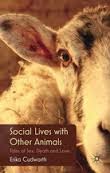
Review: Social Lives with Other Animals


You may have to be a real theory junkie to enjoy this book! I must admit, I found the first couple of chapters trying--I believe most would probably not be interested enough to continue(This is why I did not give the book 5 stars). Thus far, though, this is one of the most (if not the most) comprehensive sociological texts on human and nonhuman relationships. Most of the book is a review of the literature, exploring the fields of post-humanism, human animal studies, animal rights, and ecofeminism. I would not recommend this book for a beginner--this book is best suited to A) professionals or graduate students already in animal studies fields who are interested in the sociological literature on other animals or B) Sociologists interested in learning what the discipline has to offer species studies. I believe her intended audience is likely the latter, as there is a lot of effort put into explaining the living conditions of animals that would be well understood by those already studying animal issues. Indeed, while Sociology has historically been extremely exclusionary when it comes to other animals (a frustrating short sight given the emancipatory/critical nature of the field), Cudworth is able to ground the growing interest in animal studies in a rich(and interdisciplinary) body of work from contemporary Sociologists all the way back to the founding theorists(Marx, etc.). 

Again, the first chapters are primarily a review of the literature, but the meat of the book unpacks important concepts in speciesism. Chapter 4 covers the important gender variable in our relationships with other animals based on the work of Carol Adams. Though he is not referenced, Brian Luke's theory of masculinity and animal violence is heavily evidenced in her discussion of gendered foodwork and animal industry. Chapter 5 offers an overview of the institutionalized violence animals endure. Chapter 6 makes the case that humans and other animals have meaningful relationships. She explores this with an ethnographic study of human-nonhuman communities that form around dog-walking.


As with any social scientist worth paying attention to, she grounds her theory in emancipatory anti-speciesist practice. She extends quite a bit of effort criticizing some prevailing positions that, on the surface, may seem to be critical of speciesism, but ultimately make serious exceptions for continued oppression (so long as that oppression is made "nicer"). Cudworth introduces the concept of an "anthroparchy" to specifically view our relationship with other animals as a system of domination, oppression, and marginalization. Speciesism is not so simple as a mere prejudice for other animals--it is a historically situated project of human supremacy and animal exploitation. It is a system that benefits humans at the expense of vulnerable nonhuman animals. Addressing this system means ending this system, not reforming it. 

A side note--something I couldn't help but take issue with--she mentions that Gary Francione is rightly critical of reform approaches. However, she claims that he incorrectly has faith in law (and, thus, the state) in liberating other animals. I think this is a mischaracterization of his approach. She is right to say that he is critical of the law as it stands, but Francione believes that grassroots bottom-up vegan education that attacks speciesist ideology is the preferred strategy (and he is extremely critical of legal campaigns that seek to improve laws for animals). Francione operates according to a simplistic "supply and demand" logic that supposes that 1. Attacking speciesist ideology with vegan education and 2. Increasing vegan numbers to create a critical mass will 3. Dismantle speciesism. Nibert's approach is probably a better criticism to Francione's work in this regard, as Nibert places more emphasis on the inherent oppressiveness of the capitalist system. Most Sociologists agree that a capitalist state will always be oppressive. Francione seems to think that capitalism can work in favor of animals if we replace non-vegan industry with vegan industry. Perhaps this is what Cudworth was hinting at in her criticism, but her exploration into Francione's approach did not exceed more than a couple of sentences. Francione certainly isn't making the case that we look to the state to save animals. Indeed, he is highly critical of state institutions, bureaucracy, and hierarchy. However, Francione seems to think that the economy reflects ideology, but Sociology argues the opposite--ideology (and institutions) reflect our economic mode of production. Therefore, any attack on speciesism must also be an attack on capitalism.

Because this book is terribly dry at times (as it is basically an extensive summary of theory), I would not recommend it to the lay reader, but would probably suggest David Nibert's work instead or at least read them together. Nibert's work makes very similar arguments but is written in a more engaging way. Cudworth's book is probably best reserved for the serious academic or researcher. On the other hand, Cudworth's nuanced discussion of gender, foodwork, and animal exploitation, however, (heavily influenced by Carol Adams' sexual politics of meat) is an important extension on Nibert's work. 

All in all, a very useful addition to the growing Sociology of critical animal studies. Worth having on the shelf as an excellent resource and reference to the field. If you want to learn the sociological position on animal oppression--this is the "go to" text. For seasoned Sociologists, Cudworth's case for the inclusion of species politics is remarkably solid--I can't imagine any social scientist walking away from this book unconvinced. Nonhuman animals are part of our lives and part of our social world. We form relationships and communities with them. We benefit from them. They structure our reality. They also exist within systems of oppression in much the same way that vulnerable humans do--a relationship of violence that we have a moral obligation to recognize.