Showing posts with label Capitalism. Show all posts

Wednesday, March 18, 2015

Donations & The Small Print in Animal Advocacy


How often do you check the 990 IRS form for your favorite non-profit before you donate? I think many readers would be shocked to learn how often non-profit claimsmaking seriously mismatches its actual financial situation.

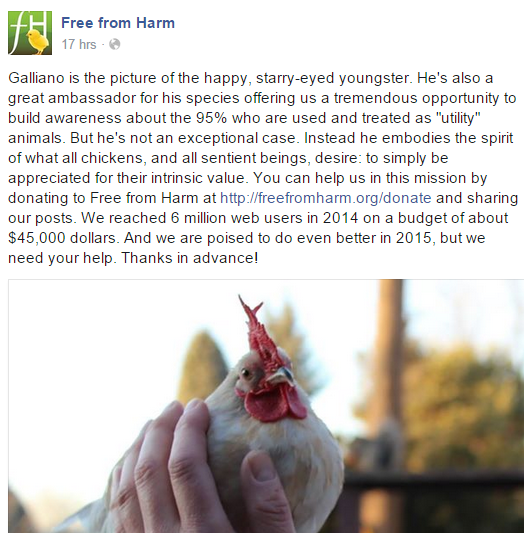
Free From Harm claims it reached 6 million web users in 2014 with a budget of only $45,000. This information is part of a call for donations. The assumption is, the more money you donate, the more money it can put towards outreach.

Free From Harm Facebook Post: "Galliano is the picture of the happy, starry-eyed youngster. He's also a great ambassador for his species offering us a tremendous opportunity to build awareness about the 95% who are used and treated as "utility" animals. But he's not an exceptional case. Instead he embodies the spirit of what all chickens, and all sentient beings, desire: to simply be appreciated for their intrinsic value. You can help us in this mission by donating to Free from Harm at http://freefromharm.org/donate and sharing our posts. We reached 6 million web users in 2014 on a budget of about $45,000 dollars. And we are poised to do even better in 2015, but we need your help. Thanks in advance!"

While I was not able to access the 2014 records, 2013 records are publicly available. In 2013, Free From Harm pulled in $92,000 from a grant, and only $20,000 of that was spent on social media outreach and web fees (the only major expenditure listed). About $70,000 was leftover in cash, savings, and investments. 

Given that billions of Nonhuman Animals like Galliano are desperately in need and could be hugely benefited if that surplus was unlocked, why not spend it? Why sit on the profits? Why am I being asked to donate when Free From Harm has more money than it can use? 

In fact, many non-profits hoard their income in this way. Non-profits act according to a capitalist logic of economic growth whereby bigger is thought to be better. Like most non-profits, Free From Harm likely hopes to achieve the status of Farm Sanctuary or PETA. Getting to that size will necessitate offices and paid staff. Interestingly, Free From Harm was not long ago crowdfunding in advocacy spaces looking for donations to support a salary for one of their volunteers. This occurred in spite of evidence in the 990 IRS form indicating that the organization has several thousands of dollars on hand that are not being put towards outreach.

Non-profitization has its benefits, to be sure. Becoming a non-profit means access to these huge grants, salaried activism, free postage from the government, relaxed repression from the state (as a group must deradicalize and become transparent in order to achieve the privilege of non-profit status), and increased public presence which is helpful for dispersing claimsmaking, but also for bringing in more funding. But the focus on growth is expensive. 

Counterbalancing these benefits are the many costs to the group's goals and tactics. Free From Harm has been known to take some questionable positions on racism in the Nonhuman Animal rights movement, as well as ableism. Many professionalized non-profits are hesitant to take a stand against human oppression, as capitalizing on racism can be profitable to the group. Free From Harm also features many essays from famous welfarists who are regularly hostile to abolitionist advocacy. This is probably because the celebrity association is more important for traffic than abolitionist veganism. To be fair, I think it is amazing that an education-based vegan group was able to land such a large grant. I do worry, however, that the logic of growth will undermine these goals as Free From Harm (and other groups like it) climb to the top.


A final point. The commodification of advocacy is a growing trend in social change spaces, and one that should be seriously reevaluated. In a heavily non-profitized social movement, meaningful, engaged, collective action is rarely engaged. Instead, calls to action are merely replaced with calls to donate. This serious squandering of advocate energy and people power is perhaps the greatest cost of all.

Thursday, March 5, 2015

Reining in the Elephants: Thinking Critically about Single-Issue Campaigns


Before I begin this article, I want to start out by saying that I am happy for the handful of elephants who will never again step foot in a Ringling Bros. and Barnum & Bailey Circus. But for the remaining elephants who will continue to be exploited in the circus's "conservation" facility, the camels that are being added to the show to take their place, and the billions of animals who have been snubbed by the Nonhuman Animal rights movement as activists rally around charismatic species like circus elephants while ignoring the importance of veganism, I continue to mourn. Not to rain on the parade, but it is at this time we should give pause and think critically about our tactics and goals.

The first thing that strikes me about this "victory" is how it is being handled by the circus itself as a means to improve their image and improve sales. The circus corporation writes:
This is the most significant change we have made since we founded the Ringling Bros. Center for Elephant Conservation in 1995. When we did so, we knew we would play a critical role in saving the endangered Asian elephants for future generations, given how few Asian elephants are left in the wild. ...This decision was not easy, but it is in the best interest of our company, our elephants and our customers.
Gosh, if I didn't know any better, I'd say this circus is the elephants' best friend! This process is known as "humane-washing." It happens when a company uses the rhetoric of "humane" to increase sales and public comfort with their inherently problematic product. This is not unique to the circus. Consider the following excerpt from Eco-Business: A Big-Brand Takeover of Sustainability (2013) by Peter Dauvergne and Jane Lister. Walmart and other large companies that profit from suffering are:
[ . . . ] taking over the idea of sustainability and turning it into a tool of business control and growth that projects an image of corporate social responsibility [ . . . ] 
[It is] proving to be a powerful strategy for corporations in a rapidly globalizing economy marked by financial turmoil and a need for continued strategic repositioning. It is also enhancing the credibility and influence of these companies in states, in civil society, in supply chains, and in retail markets. And it is shifting the power balance within the global political arena from states as the central rule makers and enforcers of environmental goals toward big-brand retailers and manufacturers acting to use "sustainability" to protect their private interests." (p. 2)
We must be suspicious when a company appears to be appealing to customer demands for a "humane" or "sustainable" product when the business itself continues to profit from the exploitation of the vulnerable. By taking the initiative, the corporation retains the power to define both the problems and the solutions. It is infinitely wiser for the corporation to act first to superficially address ethical concerns before the state steps in to create those definitions for it. What does it mean when corporations like Barnum & Bailey are in charge of "liberation" and "conservation"? Customer concerns are placated, future restrictions from the state are avoided, and the strategy actually becomes marketable.

Customers and activists alike can feel good about the circus now. However, as with many corporate-driven attempts to improve ethical problems, the improvements tend to be relatively meaningless and hide continued issues. Abolitionist project "My Face is On Fire" (MFIOF) reports on the new home for the "liberated" elephants:
This center is basically a breeding and training center. They loan out elephants and/or provide sperm to zoos so that they can stay well-stocked with elephants for their own customers. The Center has been criticized repeatedly for being a dreary place for the elephants. It's sometimes been called the elephant equivalent of a puppy mill. So how is this a victory for the elephants?
Even PETA calls bullshit. The "conservation center," Newkirk insists, is a for-profit enterprise that continues to hurt elephants under the guise of charity and with all of the benefits that a true charity might receive in the form of government and public support.

Ultimately, this is the corporation taking matters into its own hands to capitalize on the public's concern for animals in order to rebrand itself as "humane" and "sustainable." Make no mistake, this circus continues to enslave and exploit many other species. But as non-animal acts like Cirque du Soleil seem increasingly modern and fresh, and Ringling Bros. and Barnum & Bailey seem more like archaic and outdated relics of the past, the organization knows that riding the wave of the "humane" movement will be good for business. Of course, dumping animal acts altogether is likely not an option, as the corporation is well aware that the public still sees Nonhuman Animals as objects of resource, and animals sell. Elephants bad. Camels good. This moral inconsistency is thanks in part to the Nonhuman Animal rights movement that has always prioritized "special" species and ignored vegan education efforts. MFIOF continues:
Members of the general public will probably fall all over themselves to rush to the circus over the next three years to get "one last chance" to see the elephants go through the motions they've had hammered into them by their "trainers". When they're gone, they'll no doubt breathe a collective sigh of relief (after all, elephants are like land dolphins or giant baby seals) and then feel "better" about continuing to support the circus once they're gone. After all, animal advocates are cheering, aren't they?
Retiring elephants is a corporate strategy to dilute activist pressure and improve customer confidence in their brand
So what sort of victory are we celebrating here?  Instead of embracing a consistent, holistic vegan-centric message of liberation, the movement has irrationally focused on a few popular species, succeeded in moving elephants from one prison to another, and made a wide open space for the new camel act. For that matter, activists may have had little to do with the so-called "victory" at all. Barnum & Bailey is on elephant conservation like Walmart is on organic veggies.

If single-issue campaigns are so limited in their impact, so dependent upon unethical corporate interests to succeed, and so expensive in the resources they require, why engage them at all? In response to the "victory," T.O.F.U. Magazine writes:
Yes, there's more to be done, but everyone needs to know that progress is possible. 
That, I believe, is one of the main reasons that single-issue campaigns are engaged: for activist morale, not for effectiveness in the grand scheme. Activist morale is, of course, important to sustain a movement, but when the psychological needs of human activists surpasses effective strategy, it is time to get critical about what tactics we are choosing and why.

The Abolitionist Vegan Society writes:
Brace yourselves, abolitionists. Here come the "Victory!" (fundraising) emails from the nonabolitionist orgs because of the Ringling Bros. news.
Indeed. Perhaps even more important than upholding morale, single-issue campaigns are tools for fundraising. This is a point I explore in an article published in the academic journal, Food, Culture & Society (please email me for a full text copy if you are interested).  Again, this is less a matter of effective liberation strategy, and more of a matter of financial sustainability. Campaigning to reform or abolish "low hanging branches"--those social problems 99% of the public already agrees with, problems that generally pertain to "popular," "cute," or "majestic" animals--means that a social movement organization can count on easier access to resources. Again, it is important to take a serious look at our priorities. Are we a movement that seeks to capitalize on the public's preexisting pro-animal attitudes? Or are we a movement that seeks to challenge society's entrenched speciesism?

Decades of protesting, millions of dollars spent, and we've "succeeded" in shuffling elephants out of the circus ring and into a for-profit "breeding" center to the effect of improving the Ringling Bros. brand name. What if we'd put those resources into vegan education?


To summarize:

  1. Single-issue campaigns are generally a failure in disguise as they appear to abolish one form of oppression, but ultimately only make room for the increased oppression of others, or the oppression is simply transformed (in this case, elephants go from one jail to another, and tigers, dogs, camels, etc. will fill their space on the circus floor)
  2. Single-issue campaigns aggravate the irrational and speciesist compartmentalization of certain acts of animal oppression as especially "bad," while making invisible the higher-impact forms of animal oppression (like animal food consumption, the institution of domestication, etc.)
  3. To remain competitive, corporations will adopt superficial "humane" or "sustainable" measures to improve their brand image and increase sales
  4. Single-issue campaigns are low-impact for liberation, but beneficial for sustaining activist morale
  5. Single-issue campaigns are low-impact for liberation, but high impact for mobilizing resources
  6. Activists should consider whether or not capitalist growth is either necessary or congruent with a goal for achieving social justice (in other words, can capitalism solve our problems? Can we buy the revolution?)
  7. Activists should consider if their need to feel effectual is more important than actually being effectual 
  8. Vegan education may be less "exciting," but it is a higher impact form of low-cost activism that addresses all forms of oppression and avoids the problematic task of ranking which species and which forms of oppression are more important (decisions that ultimately lie on speciesist human preferences)
UPDATE 03/07/2015:  It appears that the circus's decision to cut elephants from the show also had a lot to do with the high levels of tuberculosis that are difficult to control among exploited elephants. Again, this is not a victory, this is a business move. 


Wednesday, February 4, 2015

Join the Vegan Club for the Low, Low Price

Vegan Outreach has repeatedly explained in a number of essays, position statements, and interviews that they do not want a "vegan club."  A consistent vegan position, they explain, is sanctimonious and off-putting. Vegans are angry, loud, and too concerned with morality. "Meeting people where they are," they insist, is a more "practical" approach. What this means is that promoting reductionism (eating less "meat" or "humanely-raised" "meat," vegetarianism, flexitarianism, etc.) is most appropriate. In order to protect this compromised position, they spend a great deal of effort "bashing" veganism. So, imagine my surprise when I received an email invitation from Vegan Outreach this morning asking me to join their vegan club.

That's correct, Vegan Outreach has launched their own vegan club and you don't even need to be vegan to join. True to Vegan Outreach practicality, one only needs to fork over $120.  In other words, their club membership is a monthly $10 donation. It is membership by proxy.

When Vegan Outreach says they don't want a "vegan club," what they mean is that they are opposed to holding veganism as the baseline, a basic requirement for taking the interests of Nonhuman Animals seriously.  A vegan club to them is a nonpolitical, non-active, non-involved donor. Vegan or not vegan, it doesn't matter as long as you pay up and buy stuff.

The following is pulled directly from today's Vegan Outreach newsletter (I've included the sexist "Chicks Dig Vegans" logo for context. It appears sexism is becoming as standard in animal advocacy as donating as activism).


Making a Difference without Breaking the Bank!

Sticker
Cookbook
A $120 donation may sound like a lot, but what about $10 a month? That’s less than four cents a day, but it makes a big impact for animals! You can sign up now for an automatic monthly donation to Vegan Outreach, and make a huge difference by giving a little at a time throughout the year! And you’ll become a member of the “Vegan Club” through VO’s membership program, making you eligible for awesome gifts like our Chicks Dig Vegans bumper sticker, a copy of Betty Goes Vegan, and so many others!
Check out our membership levels, thank you gifts, and ways to give at VeganOutreach.org/membership.

The first course of action for anyone who wants justice for Nonhuman Animals is to go vegan. The second course of action is to educate others about veganism. Donating is not activism (and "activism" of this sort is reserved only for the privileged few who can afford it). We cannot buy the revolution. When non-profits convince a generation of would-be activists that we can change the world if we just pull out our credit card, we've already lost the battle.  When non-profits that claim to represent the interests of vulnerable Nonhuman Animals convince a concerned public that reduction and donation will satisfy their obligations to Nonhuman Animals, this movement is a movement no longer. Rather, it is simply another moneymaking capitalist venture.

NOTE: Vegan Outreach issued a correction: 
In encouraging you to consider a monthly donation to VO, we said that $10 a month breaks down to four cents per day, when actually, it's forty cents per day. [ . . . ] PS. Coincidentally, four cents a day does add up to $36 a year, which, as a one-time donation, would make you an official Member of The Vegan Club and get you some pretty neat membership gifts as well.


Sunday, June 22, 2014

Seeing "Euthanasia" as an Extension of the Capitalist Project

Oftentimes we explore the problem of “euthanasia” (generally a euphemism for the killing of healthy dogs and cats) as a basic matter of morality or rights ethics. I argue that we should also be exploring this as an extension of anti-capitalist efforts as well.  Norm Phelps has argued that the dog and cat industry is a capitalist one, with consumers encouraged to purchase designer dogs and cats and to dispose of them when trends or lifestyles change.  “Shelters,” he argues, are to the dog and cat industry as the landfill is to other material goods. Shelters exist to dispose of unwanted dogs and cats who are continually produced, consumed, and disposed of in a constant capitalist cycle. Euthanasia is an essential component to capitalism.


The arguments for euthanasia are really quite disturbing in this light, especially given similar projects designed to eliminate unwanted human populations that are a burden on the capitalist treadmill. I have heard it argued that not killing dogs and cats waiting on homes is “a waste of people’s time and money.”  Ironically, I saw this argument made in an anti-capitalist animal rights space. But this is the very logic of capitalism, that is, to view sentient beings as disposable objects measured by their monetary value.  Strange, when it comes to privileged groups, where there's a will, there's a way. When it comes to devalued groups, killing is just "common sense."

When a sentient being is deemed a burden to the capitalist system, that sentient being becomes extremely vulnerable to suffering and death. Recall Jonathan Swift’s satirical essay A Modest Proposal for Preventing the Children of Poor People from Being a Burden to Their Parents or Country, and for Making them Beneficial to the Public, which suggests that the burdensome poor Irish could be repurposed for wealthy persons . . . killed and served up as food.


Consider also “overpopulation” rhetoric which is promulgated by wealthy Western nations who see the masses of poor in third world countries as a burden on the capitalist system (similar programs have targeted poor women of color in the United States as well). “Population control” efforts invariably target vulnerable poor persons, usually brown, and usually women.  These efforts are intended to annihilate entire groups of people—masked as “family planning,” they are often dangerous, non-consensual, and life-threatening.


The notion that vulnerable groups can be “euthanized” or “controlled” “for their own good” (a position held by privileged groups), that euthanasia is a "rational" matter to save “people’s time and money” is the language of oppression . . . capitalist oppression. We should be critical of this line of thought.  It won’t get us any closer to liberation. It only normalizes exploitation and objectification. 


Saturday, April 26, 2014

Review: Social Lives with Other Animals


You may have to be a real theory junkie to enjoy this book! I must admit, I found the first couple of chapters trying--I believe most would probably not be interested enough to continue(This is why I did not give the book 5 stars). Thus far, though, this is one of the most (if not the most) comprehensive sociological texts on human and nonhuman relationships. Most of the book is a review of the literature, exploring the fields of post-humanism, human animal studies, animal rights, and ecofeminism. I would not recommend this book for a beginner--this book is best suited to A) professionals or graduate students already in animal studies fields who are interested in the sociological literature on other animals or B) Sociologists interested in learning what the discipline has to offer species studies. I believe her intended audience is likely the latter, as there is a lot of effort put into explaining the living conditions of animals that would be well understood by those already studying animal issues. Indeed, while Sociology has historically been extremely exclusionary when it comes to other animals (a frustrating short sight given the emancipatory/critical nature of the field), Cudworth is able to ground the growing interest in animal studies in a rich(and interdisciplinary) body of work from contemporary Sociologists all the way back to the founding theorists(Marx, etc.). 

Again, the first chapters are primarily a review of the literature, but the meat of the book unpacks important concepts in speciesism. Chapter 4 covers the important gender variable in our relationships with other animals based on the work of Carol Adams. Though he is not referenced, Brian Luke's theory of masculinity and animal violence is heavily evidenced in her discussion of gendered foodwork and animal industry. Chapter 5 offers an overview of the institutionalized violence animals endure. Chapter 6 makes the case that humans and other animals have meaningful relationships. She explores this with an ethnographic study of human-nonhuman communities that form around dog-walking.


As with any social scientist worth paying attention to, she grounds her theory in emancipatory anti-speciesist practice. She extends quite a bit of effort criticizing some prevailing positions that, on the surface, may seem to be critical of speciesism, but ultimately make serious exceptions for continued oppression (so long as that oppression is made "nicer"). Cudworth introduces the concept of an "anthroparchy" to specifically view our relationship with other animals as a system of domination, oppression, and marginalization. Speciesism is not so simple as a mere prejudice for other animals--it is a historically situated project of human supremacy and animal exploitation. It is a system that benefits humans at the expense of vulnerable nonhuman animals. Addressing this system means ending this system, not reforming it. 

A side note--something I couldn't help but take issue with--she mentions that Gary Francione is rightly critical of reform approaches. However, she claims that he incorrectly has faith in law (and, thus, the state) in liberating other animals. I think this is a mischaracterization of his approach. She is right to say that he is critical of the law as it stands, but Francione believes that grassroots bottom-up vegan education that attacks speciesist ideology is the preferred strategy (and he is extremely critical of legal campaigns that seek to improve laws for animals). Francione operates according to a simplistic "supply and demand" logic that supposes that 1. Attacking speciesist ideology with vegan education and 2. Increasing vegan numbers to create a critical mass will 3. Dismantle speciesism. Nibert's approach is probably a better criticism to Francione's work in this regard, as Nibert places more emphasis on the inherent oppressiveness of the capitalist system. Most Sociologists agree that a capitalist state will always be oppressive. Francione seems to think that capitalism can work in favor of animals if we replace non-vegan industry with vegan industry. Perhaps this is what Cudworth was hinting at in her criticism, but her exploration into Francione's approach did not exceed more than a couple of sentences. Francione certainly isn't making the case that we look to the state to save animals. Indeed, he is highly critical of state institutions, bureaucracy, and hierarchy. However, Francione seems to think that the economy reflects ideology, but Sociology argues the opposite--ideology (and institutions) reflect our economic mode of production. Therefore, any attack on speciesism must also be an attack on capitalism.

Because this book is terribly dry at times (as it is basically an extensive summary of theory), I would not recommend it to the lay reader, but would probably suggest David Nibert's work instead or at least read them together. Nibert's work makes very similar arguments but is written in a more engaging way. Cudworth's book is probably best reserved for the serious academic or researcher. On the other hand, Cudworth's nuanced discussion of gender, foodwork, and animal exploitation, however, (heavily influenced by Carol Adams' sexual politics of meat) is an important extension on Nibert's work. 

All in all, a very useful addition to the growing Sociology of critical animal studies. Worth having on the shelf as an excellent resource and reference to the field. If you want to learn the sociological position on animal oppression--this is the "go to" text. For seasoned Sociologists, Cudworth's case for the inclusion of species politics is remarkably solid--I can't imagine any social scientist walking away from this book unconvinced. Nonhuman animals are part of our lives and part of our social world. We form relationships and communities with them. We benefit from them. They structure our reality. They also exist within systems of oppression in much the same way that vulnerable humans do--a relationship of violence that we have a moral obligation to recognize.

Monday, April 14, 2014

Review: The Ecological Hoofprint

The Ecological Hoofprint:  The Global Burden of Industrial Livestock was recommended to me by David Nibert as it is sociologically oriented and critical of animal product consumption.  It provides an excellent summary of the major environmental arguments against meat in the context of global inequality and the agricultural industrial complex.  It is a good companion to Meatonomics, This is Hope: Green Vegans and the New Human Ecology, and David Nibert’s work.  In general, I think this work is an excellent introduction into the sociology of food systems and environmental sociology.  It also speaks to animals & society discourse, though it is decidedly anthropocentric and speciesist in its conclusions.

It is very intersectional and critical of capitalism, tracing the historical process towards the system we have today. Weis argues that, in earlier times, most energy came from the sun (rather than fossil fuels) and travel was restricted because it was not efficient (a phenomenon he calls the “friction of distance”). Because the farmers couldn’t move around much, they had to take care of what resources they had locally available and farm more responsibly.  However, capitalism eroded this friction of distance with the rise of globalization and colonialism.  This has led to large scale environmental destruction and climate change.


The book also discusses how environmentalism has been framed in a way that obscures problems and protects capitalist interests.  Weis is refreshingly critical of the overpopulation rhetoric that blames environmental degradation on population (i.e. poor people and vulnerable communities).  This position ignores the role that livestock production plays.  He calls this focus on human population “corporate greenwash” and is critical of how technology, development, and capitalist growth are reframed as solutions, when they are, in fact, the problem.  Overpopulation rhetoric obscures global inequality and focuses on the more easily targeted “distant other”:
Rather than the persistence of high fertility rates being a cause of poverty and degradation, critics counter, these are better understood as a symptom or an effect of things like class, patriarchy, and other inequalities, and the dependence of the poor upon children for such things as labor and old-age security. (35)
This is perhaps the crux of his argument: We are ignoring the Nonhuman Animal component:
The ecological footprint presents a call to understand consumption in terms of the bundles of land, water, resources, pollution, and GHG emissions embedded in production, and in turn the tremendous environmental dimension of economic inequalities. The ecological hoofprint seeks to connect and extend some of these basic concerns to a different and much bigger ‘population bomb’ than what environmentalists have long focused upon: that which is occurring within systems of industrial livestock production. (50) 
A primary goal of the ecological hoofprint as a concept and metaphor is to call attention to the large, wide-ranging, and highly uneven burden of industrial livestock production.  To do this, it develops a political ecological framework for understanding the industrial grain-oilseed-livestock complex as a system in motion, and how its fundamental economic logic (or imperatives) gives shape to the social and ecological relations of production, including the associated instabilities and the ways they are overridden. (52)
Unfortunately, Weis operates under the assumption that animal products are good for human health, which is indicative that he has not addressed the volumes of research that have demonstrated quite the opposite.  He also hangs on to the falsehood that animal production could ideally be beneficial to humanity, even suggesting that small scale animal agriculture can be beneficial to the environment.  However, he does admit that not all societies relied on livestock or required it.  He also challenges the “contract” justification between humans and other animals (the fantasy that Nonhuman Animals happily give up their children, labor, and lives to be "cared for").  He rightfully refers to this as violent and evidence of human supremacy.  Much of the book also reiterates Nibert’s arguments and claims that animal agriculture is inherently tied to class and gender exploitation as well as colonialist expansion.  The rise of animal agriculture is a project of colonization and oppression.

To some degree, Weis is critical of the objectification of Nonhuman Animals and is quite critical of welfare reform (as it supports the logic of capitalism and only seeks to make industry more efficient).  However, it appears that the return to Old MacDonald's Farm is his ultimate desire:
An ecologically rational conception of efficiency thus turns a basic tenet of modernization on its head: rather than technology displacing labor in large monocultures, there is a need for labor and knowledge to displace mechanization. [ . . . ] In the course of rethinking efficiency, ways must be found to ensure equitable outcomes that valorize the labor, skill, and ecological services of bio-intensive farms [ . . . ].  What this analysis makes clear, though, is that dismantling the industrial-grain-oilseed-livestock complex is at the very center of any hopes of making world agriculture more sustainable, socially just, and humane” (149).
Weis suggests the “livestock population bomb” be addressed to reduce the livestock population dramatically.  He ends with a discussion of vegetarianism, humane farms, and veganism, but is very wishy-washy about veganism, indicating
that it is unrealistic or unnecessary.  This, I believe, is the greatest weakness of the book. Though the majority of the book was astonishingly intersectional, well-argued, and sociologically-sound, his stubborn refusal to seriously acknowledge the scientific research demonstrating the toxic effect of animal products on human health makes this book one I would probably not recommend.  No book that claims to take on environmental problems and issues of social justice but sells out the animals and continues to view them as expendable commodities will be credible social science in my opinion.  For this reason, I would direct readers interested in these topics to the books recommended at the beginning of this review, primarily that of David Nibert.

UPDATE 04/16/2014:

The author has since contacted me and is not happy with some of the conclusions I've drawn, specifically in my claims that he does not address the health risks of animal-based diets and the desire for a turn to "humane" farming practices.  I encourage readers to read the book for themselves and form their own conclusions.  This essay is a reposting from a review I posted on my Goodreads.com account. In that review, I gave the book 4 out of 5 stars, as I do think the book has quite a bit to offer the field. Given the choice, however, I would still recommend Meatonomics, This is Hope, or Nibert's 2002 and 2013 publications over this one.

Monday, March 24, 2014

How Non-Profitization Euthanizes Animal Activism

Euthanasia implies a "soft" killing, one that is not done maliciously, but takes life by surprise, so to speak, or without full awareness. In this manner, dogs and cats are killed by the millions each year under the premise that this is a rational strategy in the face of insurmountable speciesism.  But I don't think this is a species-specific phenomenon; I think it is endemic to advocacy spaces.  We have nurtured this ideology of unpleasant but necessary institutionalized death in the interests of other animals as a movement ethic.

The animal rights movement is being quietly killed behind the closed doors of non-profits.  Many advocates abhor the term "euthanasia," a euphemism that suggests dogs and cats are killed with mercy, when in fact they are usually healthy animals that are not so much victims of homelessness as they are of bureaucratic carelessness. But the bureaucracy of animal rights is killing more than dogs and cats; it's killing our movement.


Somewhere along the line, the great capitalist state has convinced social justice advocates that incorporating into the non-profit system will be a good thing. Not just a good thing, but the epitome of activism. As we are all indoctrinated with capitalist values, we look to non-profits as the natural progression in social movement mobilization. Becoming a non-profit means access to grant money, free postal service, tax exemption, and government support. But it also means an organization's ability to lobby is severely limited and they must make all of their operations transparent to state surveillance.

Another benefit to becoming a non-profit is the ability to make a living at social change. We have bought into the idea that we can make a living off of the immense suffering of other animals. We can pull a salary. Where did we get this fantastical idea that radical structural change can also pay our bills?  It should also come as no surprise that making a career out of social change is a privilege that is reserved mostly for well educated, well networked persons--usually white, straight, able-bodied men from Western nations.

In my opinion, non-profit incorporation is a death sentence. A group cannot hope to change oppressive social structures on one hand when, on the other hand, it relies on those oppressive social structures to remain in business. Becoming a non-profit necessitates a compromised message to keep conservative donors on board.  The state nurtures this system because it effectively stamps out the threat of serious social agitation. It also benefits from the cheap labor of non-profits that attend to social services the state has neglected in its catering to capitalist enterprise.

Non-profitization is killing us softly. As much as we love slick websites, glossy magazines, and salaries, these are detracting from the important grassroots work that is absolutely essential to real change. We cannot expect social change to pay the bills. In fact, disadvantaged communities have been doing social justice work for free for many decades. Social change is made by lawyers, teachers, business owners, service workers, factory workers, scientists, doctors, nurses, mothers, fathers, children, and even the unemployed...not by professional grant-writers. Grant-writers make money, not change.

HSUS pulled in $125 million in 2012

Non-profits, despite their title, are businesses. They raise money, they make money, the grow money, they employ staffs, and they are good for the economy. Vegan Outreach, for example, spent about 70% of their approximately one million dollars in intake for the 2011-2012 year on services unrelated to outreach. That's a lot of money going into other people's pockets. Considering that Vegan Outreach is one of the smaller animal rights organizations, it is staggering to imagine how many millions of dollars the animal rights movement is raising and spending on bureaucratic expenditures instead of putting it directly towards anti-speciesism work. Capitalism loves non-profits.

We need to step away from the misguided notion that more money=more change. The capitalist ethos of "more is better" and the fetishization of bureaucratic growth is what created the problem in the first place. Social change is hard work, but not everyone can expect to be compensated for it. It will take mass volunteerism. All skills must be welcomed and valued, not just the ability to write grants or donate money. Do not be led to the gas chamber that is the non-profit industrial complex.

Monday, February 24, 2014

Why the Abolitionist Approach Cannot Succeed

Kim Stallwood has been tweeting all day with variations of this request:

Okay, I'll bite.

There are no examples, nor are there likely to be any in the near future. Abolitionism hasn't achieved much of anything.

But not so fast...

The prompt is obviously designed to elicit a simple admission of failure, but it is both leading and dishonest. Really, it reminds me of my ignorant white friends who blame people of color for being poor. It also reminds me of well-to-do people who blame poor persons for being on welfare. Or those who blame women for being poor, underpaid, devalued (or even raped). If they aren't succeeding, it must be their fault, right?

Social Movement Inequality and the Welfarist Hegemony

Most of us recognize that these positions are not telling the whole story. As with social inequality, the social movement arena also has a set of power dynamics that we must consider. In the same way that a patriarchy is set up to benefit certain groups (men) and disadvantage others (women) and a white supremacy is set up to benefit certain groups (whites) and disadvantage others (people of color), the welfarist hegemony is designed to benefit professionalized welfarist groups and disadvantage radical grassroots groups (this trend holds true for all social movements). Men and white people have all the money, prestige, and opportunities, and, as an extension of that, they also get to make the rules, dominate claimsmaking, and create meaning and ideologies that support their supremacy. Welfarist organizations are no different.


Even small non-professionalized groups can benefit in this system by adhering to the value-structure welfarists have created. Small groups might not have access to the huge pool of resources that PETA and HSUS have, but they can tap into the power of their claimsmaking and networking. When a small group rallies against gestation crates, for example, they are drawing on the ideological power of Mercy for Animals. They can also call on MfA for leaflets, volunteers, and other supports. If they promote ethical veganism and avoid reform campaigns, they get the cold shoulder and suddenly have a lot more difficulty finding grants and institutional support. Again, this is typical of all social movements. By way of an example, the gay rights movement is dominated by large groups like the HRC that prioritize reform (like gay marriage), while the smaller groups that focus on those issues that aren't profitable to the large non-profits (like gay homelessness) get squeezed out.

In a system like this, where large groups have dominated the ideological landscape and control almost all of the resources available to the movement, the abolitionist faction simply doesn't have a chance. PETA, HSUS, MfA, CoK, FARM, Farm Sanctuary, Vegan Outreach and others rake in almost all of the donations, they have all the state/industry/elite/foundation connections, and they enjoy the ability to frame animal rights and what "effective" activism is. In doing so, they make it nearly impossible for anyone else to advocate. Abolitionists (and other radical activists like those in the No Kill faction) are left with table scraps. We're shouting to be heard from down on the floor at the ankles of the big organizations that sit at the feasting table of the non-profit industrial complex.

My point here is that it is illogical to misconstrue social movement inequality with social movement inefficacy. If abolitionists had equal access, then maybe we could start to judge how well vegan education and anti-speciesist values could work. But we lack the funding, and large organizations refuse to give veganism a chance. What's more, they spend a whole lot of time denigrating anti-speciesist rhetoric and portraying veganism as "hard" or elitist."

Welfarists do Welfare

The other important problem with Kim's question is that he assumes that welfarists and abolitionists want the same thing. Welfarists want reform and they have the resources to seek reform, so that's what they get. As Gary Francione has explained, this success is easily achieved, not only due to the vast resources welfarists enjoy, but also because these reforms are mostly desired by industries that capitalize on public concern for animal welfare. See this new outreach poster he has been circulating:


In the words of Roger Yates, welfarists do welfare. Abolitionists don't want legal reform, we want abolition. In a grossly speciesist world that exploits billions of Nonhuman Animals and in a movement culture that more or less condones it, laws are wholly inapplicable. No law passed in a speciesist society will do anything to help animals. Lest we forget, the legal system is an institution designed to protect and promulgate the interests of the privileged. As Gary Francione explains in Animals, Property and the Law (echoed by several other legal philosophers like Lee Hall and David Cassuto), any law we pass in the current political climate will only work to cement speciesism. Abolitionists don't want legal change...at least not yet. One of the foundational principles of abolitionist animal rights is to first advocate for veganism and create a critical mass of vegans, and to then work to change laws to reflect these new social attitudes. With less than 2% of the American population identifying as vegan, we're not ready for legal action yet.

Abolition Strategy

I titled this essay "Why the Abolitionist Approach Cannot Succeed," not because I think it is a lost cause, but because I think we have some serious institutional barriers to overcome.  Vegan Outreach alone raked in a million bucks last year and then squandered it all on reductionist, anti-vegan nonsense. Just imagine what change we could make if the movement redirected its resources towards a genuine animal rights message. PETA pulled in about 31 million dollars last year. What if PETA quit labeling No Kill advocates as hoarders and started funding adoption strategies? HSUS pulled in 149 million dollars. What if HSUS were to stop colluding with meat industries and began countering them instead?

Do I think there is hope for the movement? For abolitionism? I do. I have dedicated my career (brief as it has been thus far!) to the position. I've seen the movement start to take notice. Kim and other big players in the movement are starting to respond. They are beginning to recognize that our position is a valid one...or at the very least a persistent one. After all, that is one of the main purposes of radical factions for any social movement: to keep the professionalized organizations that sell out to the non-profit industrial complex in check. Their wealth of resources comes at a cost. Incorporating into the capitalist model means their power to create structural change is effectively neutralized. Abolitionists may be disadvantaged in money, networking, and ideological power, but we do have the freedom from the bureaucratic non-profit spiderweb needed to keep our position honest. We can still afford to put Nonhuman Animals first.


Saturday, February 8, 2014

Blaming Individuals for Structural Oppression: Why I Can't Stand this Vegan Meme

The following meme has been making its rounds on Facebook this week. I've seen it shared by Vegan Publishers, Vegan Outreach, The Thinking Vegan, and even, I'm sorry to say, Carol Adams. Well-meaning as it may be, I find it quite offensive and counterproductive.


The meme reads:
The difference between people who state veganism is easy and those who state veganism is hard, is those who say it's easy are focused on the victims, while those who say it's hard are focused on themselves.
Allow me translate:
The difference between privileged middle-class white people who state veganism is easy, and poor persons and persons of color (who are living under institutionalized oppression and are dealing with structural barriers, environmental racism, and food deserts) who state veganism is hard, is those who say it's easy are ignoring human victims, while whose who say it's hard are focused on themselves, as they're struggling to stay alive.
And the movement wonders why veganism is considered elitist? And why brown people and poor people tend to steer clear of animal rights activism?

If we want to succeed as a movement, we must strive to be cognizant of structural barriers and how oppression restricts the freedoms of millions of people living in the United States and abroad. Blaming marginalized people for their limited choices is unfair and cruel. Instead of tooting our privilege horn, perhaps we could widen our lens and work to dismantle the oppression that hurts and kills humans as well as nonhumans.